Year of St Francis of Assisi
It is said that Francis of Assisi had times when he was withdrawing from the world and spending time in solitude and in nature, and then there were times when he felt urged to travel.
In 1219 he went on board of a crusader ship and was heading towards Egypt, one of the centres of the Muslim world in the 13th century. During the 5th Crusade which started two years prior, the Egyptian city of Damietta was targeted. From there, the crusaders wanted to proceed to conquer Jerusalem which had been under Muslim control for 300 years.
Damietta, the gate to the river Nile and seat of Sultan al-Kamil had been under siege by the crusaders for several months which had devastating consequences for the local population as well as for the crusaders.
In this situation Francis of Assisi arrives in Damietta and is adamant to meet the Sultan. Why does Francis travel on a ship with the crusaders and why does he want to meet the Sultan? Historians speculate that Francis might have reached a point in his life when he felt that he had to take risks to preach and announce the Gospel, intentionally risking his life and by doing so potentially becoming a martyr. Others are convinced that Francis followed the call in the Gospel where it says: “Blessed are the peacemakers, for they shall be called children of God” (Matt 5:9).
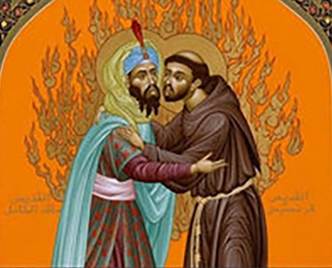
Francis manages to meet with Sultan Malik al-Kamil. Both men would have seen or at least heard of atrocities committed in the fight for Jerusalem, but they decide to talk and dialogue.
According to Latin sources, the Sultan was relatively open-minded and had been in dialogue with other religions. He was familiar with Jewish and Christian beliefs and supported the Sufi movement which promoted the idea that the religious diversity was Allah’s idea to help believers grow in their own faith.
Whatever the reason for Francis’ journey to Egypt, the Sultan does not convert, Francis does not become a martyr and peace is not restored.
Nevertheless, it is likely that the encounter had an impact on both men. Sultan al-Kamil had already tried to negotiate with the crusaders before but had been rejected. In Francis he now meets a different kind of Christian. Despite having arrived on a ship with crusaders, Francis is unarmed and ready for dialogue.
Francis is very impressed and deeply inspired by the regular public call for prayer in Egypt. He wants the Christians also to be called for prayer at least once a day. Apparently, this idea is the root for having the Angelus prayer accompanied by the ringing of the church bell. “In dialogue with the Islamic call to prayer, the Angelus Prayer calls on praising a God who, like Mary, invites us to say ‘yes’ to the good and to receive the good in order to give it back and to pass it on and who, like Francis, to challenge us to peace.” https://franciscancall4peace.org/en/bell-ringing-4-peace/
Francis of Assisi was a man of his time and yet has remained an inspiration not only for Christians for more than 800 years.
In a time when the powerful nobility and clergy were joined by wealthy traders and townspeople, accumulating money became a tool to gain respect and power. As a very young man, Francis enjoyed the privileges, but then eventually rejected this wealth and strongly despised money.
In a time when Christians and Muslims were fighting for the control over Jerusalem, when prejudices were hindering peace negotiations, Francis met with Sultan al-Kamil and later kept reminding Christians of being respectful when dealing with Muslims.
During the Second Vatican Council, Vatican II, Interreligious Dialogue was addressed and promoted in the document Nostra Aetate. More than 60 years after the promulgation of Nostra Aetate, the Vatican document A Journey Of Hope has been published where the importance of dialogue among people of different religions is reiterated: “Dialogue, therefore, presupposes a clear awareness of one’s own religious and cultural identity, together with a genuine openness to otherness, which is an indispensable condition for coexistence within pluralistic societies.”
The Note adds confirming comments by all popes since Vatican II, including Pope Leo XIV who “has sought to reaffirm the decisive role of interreligious dialogue in rejecting the logic of violence: “Those who use the name of God to legitimize terrorism, violence or war betray his true nature, for to fight in the name of religion means attacking religion itself. The ‘spirit of Assisi,’ evoked by Saint John Paul II and carried forward by Pope Francis—for example, through his dialogue with the Grand Imam of Al-Azhar—shows that believers can draw upon the most authentic sources of their particular spiritual traditions, where there is no room for ‘sanctified hatred.’” (A Journey Of Hope).
BM
For further resources on Interfaith, see: www.studyjoy.nz/2025/09/26/promoting-interfaith-relations/