The practice of Bible study on beads began with the Desert Fathers
Praying the Rosary is a deeply rooted Catholic devotion, but the origin of this cherished set of prayers counted on beads is uncertain. Its development over several centuries involves Marian apparitions and two Dominics who may have been confused with each other.
A combination of vocal prayer and meditation, this staple of Catholic piety is a structured way to reflect on key events in the lives of Jesus and his mother. It’s a form of Bible study on beads.
The practice of using beads in prayer follows the practice of the Desert Fathers, Christian hermits and monks who lived in Egypt from the 3rd century. They used pebbles in a bowl or knotted ropes to keep track when praying the 150 Psalms.
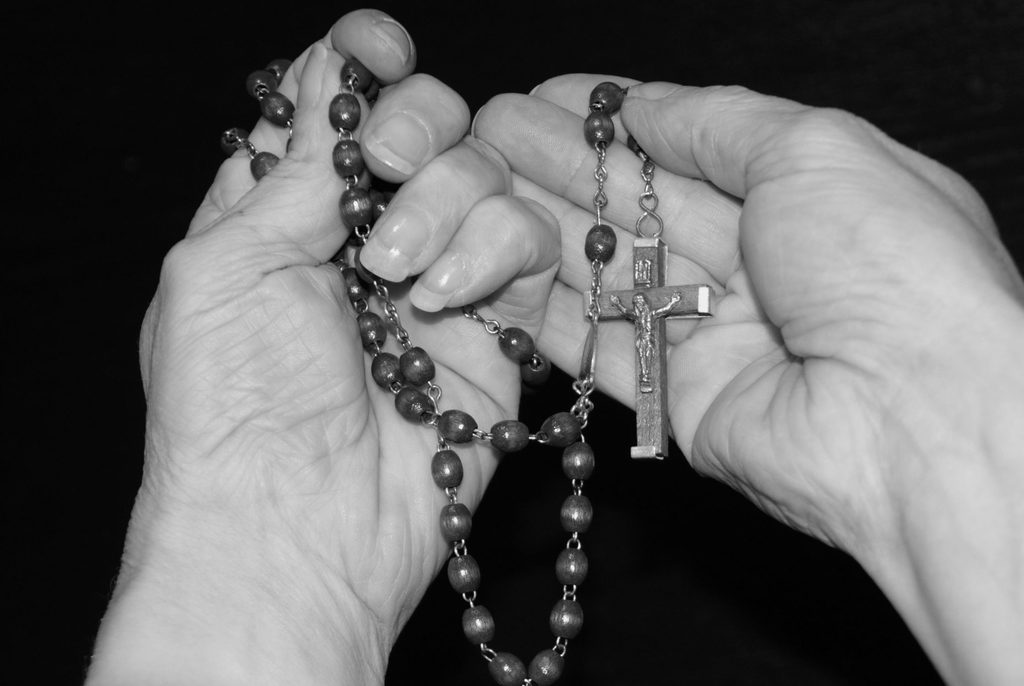
Praying repetitions of the Lord’s Prayer or Hail Mary — sometimes 150 times to echo the number of Psalms — is recorded as far back as the 9th century.
Then, a well-known tradition asserts, in the early 13th century St Dominic experienced a vision of the Virgin Mary who gave him a Rosary and showed him how to pray it.
Not documented: However, although the founder of the Dominican order is reported to have told colleagues about the vision, the meticulous documentation of his life put forward during his canonisation process said nothing about the Rosary.
Two centuries after this saint, there is evidence that a Carthusian monk called Dominic of Prussia came up with the idea of adding meditations on the life of Christ to an existing practice of saying 150 Hail Marys. He called this the Life of Jesus Rosary, and it included meditations on the Adoration of the Magi and the Flight into Egypt.
Over time the structure of the Rosary developed. The Hail Marys were divided into decades using 10 beads, the Lord’s Prayer and Glory Be were included, and the prayer form became known as the Rosarium (“rose garden”).
The Rosary gained immense popularity when a prayer campaign promoted by Pope Pius V was credited with gaining victory for the Christian fleet over Turkish forces in the 1571 Battle of Lepanto.
The following year the pope established the Feast of the Holy Rosary on October 7, the day of the battle. And in 1883 Pope Leo XIII dedicated the month of October to the Rosary.
Pius V, a Dominican, endorsed the Dominican Rosary of 15 decades — with Joyful, Sorrowful and Glorious mysteries — as the standard.
The most common form of the Rosary begins with the Lord’s Prayer, three Hail Marys and a Glory Be, followed by the recitation of five decades consisting of the Lord’s Prayer, 10 Hail Marys and a Glory Be. After each decade, some Catholics add a Fatima Prayer (O My Jesus), which was given by the Virgin Mary to three shepherd children in Portugal in 1917.
During each decade of Hail Marys it is customary to meditate on a “mystery” from the life of Christ. These mysteries are not unsolved puzzles but profound truths about Christ and his mother that transcend human understanding.
Different mysteries are traditionally prayed on each day of the week:
Mondays and Saturdays, the Joyful Mysteries: The Annunciation (Luke 1:26–38); The Visitation (Luke 1:39–56); The Birth of Jesus (Luke 2:1–21); The Presentation of Jesus (Luke 2:22–38); The Finding of the Child Jesus in the Temple (Luke 2:41–52).
Tuesdays and Fridays, the Sorrowful Mysteries: The Agony of Jesus in the Garden (Matthew 26:36–56); The Scourging of Jesus (Matthew 27:26); The Crowning with Thorns (Matthew 27:27–31); The Carrying of the Cross (John 19:16-17); The Crucifixion (Matthew 27:33–50).
Wednesdays and Sundays, the Glorious Mysteries: The Resurrection (John 20:1–29); The Ascension (Luke 24:50–53); The Coming of the Holy Spirit on the Apostles (Acts 2:1–41); The Assumption of Mary (based on early Church tradition); The Crowning of Mary as Queen of Heaven (based on Church tradition, supported by Revelation 12:1).
Thursdays, the Luminous Mysteries, added by Pope St John Paul II in 2002: The Baptism of Jesus in the River Jordan (Matthew 3:13–17); The Wedding Feast at Cana (John 2:1–11); The Proclamation of the Kingdom of God (Mark 1:14–15); The Transfiguration (Matthew 17:1–8); The Institution of the Eucharist (Matthew 26:26-29).
Reciting Our Fathers and Hail Marys while contemplating events from the New Testament might seem like contradictory multitasking. Advocates of the Rosary see the repetitive recitations as a sort of rhythmic background to the meditations.
The Congregation for Divine Worship says the Rosary is essentially a contemplative prayer, which requires “tranquility of rhythm or even a mental lingering which encourages the faithful to meditate on the mysteries of the Lord’s life”.
Many saints and popes have praised the Rosary. Pope Leo XIII — whose social teaching inspired the present pontiff to choose the same name — issued 12 encyclicals and five apostolic letters promoting it.
Pope St John Paul II called it “my favourite prayer” and Mother Teresa of Calcutta instructed her sisters: “Cling to the Rosary as the creeper clings to the tree — for without Our Lady we cannot stand.”
Rosary beads have achieved an identity of their own. They are worn by celebrities as trendy jewellery and, more devoutly, by Christian drivers on their rear-vision mirrors — perhaps attracting extra scrutiny of their driving.
Author: Pat McCarthy, Fathoming the Faith. Reproduced with permission.