The New Testament doesn’t say where Mary the mother of Jesus died, where she was buried and where she was assumed into heaven. There is Church tradition, there are early documents — but there is also controversy.
For the early Christians living in the Holy Land there was no doubt. Mary died in Jerusalem, surrounded by a group of apostles. She was buried at the foot of the Mount of Olives — and her tomb was later opened and found to be empty.
Several documents written within the mother church of Jerusalem support this tradition. They can be traced back to a single Judaeo-Christian prototype ascribed to one Lucius Carinus, said to have been a disciple who worked with John the Evangelist.
By the reckoning of one of these documents, Transitus Mariae, Mary would have been aged no more than 50 at the time of her death.
Bodily Assumption: The belief that Mary was bodily assumed into heaven from Jerusalem is mentioned in these documents and also in sermons by Eastern saints such as Andrew of Crete and John of Damascus.
But there is a competing — and controversial — claim that Mary died at Ephesus in Turkey. Here there is even a small stone building called Mary’s House, though there is no evidence she ever lived there.
And, as an example of the widespread devotional belief in the Ephesus claim, a full-sized replica of this house has even been erected at Alfonso, outside Manila in the Philippines.
The comparatively recent Ephesus tradition rests on three grounds:
1. John’s Gospel records that Jesus on the cross entrusted his mother to John, who became a leader of the Church in Jerusalem and later went to Ephesus (John 19:26-27).
2. One of the early Church councils, which settled an important controversy concerning Mary, was held at Ephesus in the year 431. It declared that Mary was the Mother of God, and the council records say it took place in “the church named after Mary”.
3. More than 1700 years after Mary died a German nun, Anne Catherine Emmerich, had visions in which she is supposed to have received a description of a house the apostle John built for Mary outside Ephesus.
The visions of this mystic (who had never been outside Germany) were transcribed by a romantic poet called Clemens Brentano. When her case for beatification was submitted to the Vatican in 1892, it was found that Brentano had made up much of the material he attributed to Catherine Emmerich. So her writings had to be excluded from consideration when she was approved for beatification in 2004.
Visit to Ephesus unlikely: Did Mary ever go to Ephesus with John, and later return to Jerusalem? It’s possible but unlikely.
John was the youngest of the apostles, so he would have been many years younger than Mary — young enough for Jesus on the cross to refer to him as her “son”.
The earliest mention of John being in Ephesus suggests he arrived around AD 60, which would have been well after Mary’s death.
Mt Zion, the highest point in ancient Jerusalem, is the place identified in the oldest Christian tradition as the place where the Virgin Mary died — or “fell asleep”, as it is customarily expressed.
Here, just outside the Zion Gate of the Old City, is the Benedictine Basilica of the Dormition, a massive, fortress-looking building with a conical roof and four slender corner towers. Next to it is the Dormition Abbey, a building with a prominent bell tower, which is the traditional location of Mary’s death.
Sleeping Virgin: In the crypt of the abbey lies a life-size statue of the sleeping Virgin made of rosewood and cherry wood, representing how she may have appeared at the time of her death.
An equally strong tradition surrounds the Tomb of Mary in the dimly-lit Orthodox Church of the Assumption at the foot of the Mount of Olives and close to the Garden of Gethsemane. The church stands partly below the level of the main Jerusalem-Jericho road.
Here, on the site of a first-century cemetery, a Crusader stairway of nearly 50 steps leads to an underground rock-cave. The smell of incense fills the air, the ceiling is blackened by centuries of candle smoke, and gold and silver lamps hang in profusion.
Cut clear of surrounding rock is a small shrine, richly decorated with Eastern icons, candlesticks and flowers. Inside it is a bare stone bench on which Mary’s body is believed to have lain. Narrow openings on two sides allow pilgrims access.
According to one Christian tradition, Mary became ill after spending the post-Pentecost years supporting the expanding Church her Son had founded.
Thomas arrived late: The apostles, scattered throughout the world, are said to have been miraculously transported to be at her side when she died. The sole exception was Thomas, who was characteristically late.
When Thomas arrived, three days after Mary died, he asked to see where she had been buried so he could bid her farewell. The grave was opened but her body was gone, leaving a sweet fragrance.
Mary’s House at Ephesus is a prayerful place with many pilgrims. Like the Tomb of Mary in Jerusalem, it is visited by both Christians and Muslims — who venerate “the Holy Mother of prophet Jesus”.
The conflict over the two competing sites was considered by the Catholic Encyclopedia back in 1912.
Never any Ephesus tradition: “Regarding the day, year, and manner of Our Lady’s death, nothing certain is known,” it said. However, “There was never any tradition connecting Mary’s death and burial with the city of Ephesus.”
Unlike Jerusalem, the Encyclopedia noted, not a single early writer or pilgrim spoke of Mary being buried in Ephesus — and in the thirteenth century Perdicas, prothonotary of Ephesus, visited “the glorious tomb of the Virgin at Gethsemane”, and described it in a poem.
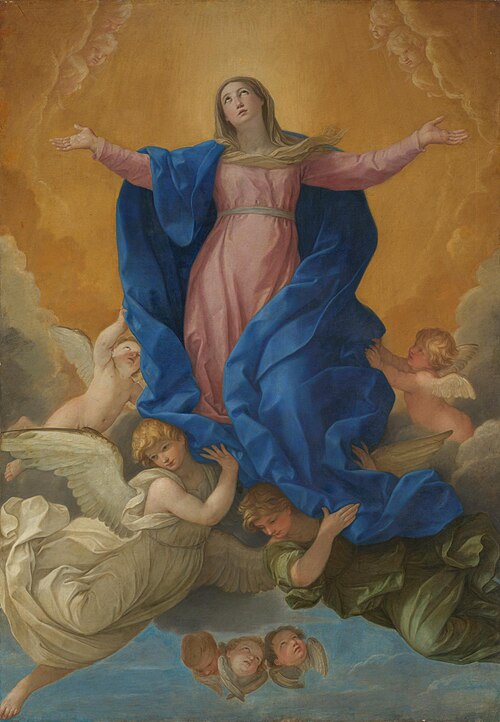
The Assumption of Mary has been a subject of Christian art for centuries (and its feast day was made a public holiday in England by King Alfred the Great in the 9th century). It was defined as a doctrine of the Catholic Church by Pope Pius XII in 1950.
The Eastern Orthodox churches celebrate the feast of the Dormition (“falling asleep”) of the Mother of God on August 15, the same day that the Catholic Church celebrates the feast of the Assumption of Mary.
Article by Pat McCarthy used with permission (https//fathomingthefaith.substack.com)