Many years ago, I watched a movie which featured a couple of children who were born at a specific time on a specific date and through the influence of extra-terrestrial circumstances, they turned out to be extremely intelligent.
First, their parents were amazed and proud of them, but when the parents realised that their children’s intelligence was far greater than that of any human being and that they were even able to read other people’s mind, the parents started to be scared of them. The children became a threat to the small-town society they lived in, and there were attempts to kill them. However, as they could read minds, they knew beforehand if someone wanted to kill them, and these people then were involved in strange fatal accidents before they could kill the children.
The parents were torn between love and pride for their children and fear for what they were able to do. In the end, the difficult decision to kill the children was taken communally with the hope to restore peace in the community.
The more we hear about AI and its capacities, the more I am reminded of this movie. First praised for their knowledge, the extraordinarily intelligent children slowly become a threat to the lives of others. The linear way of thinking which usually proceeds a human action doesn’t work with these children. They can read minds and understand the intended action without having to understand the steps that would lead to it. While the other people are still caught in details along the way and figuring out how to get there, these children already know the goal. Hence, they can prevent the action before it is carried out and destroy the threat against them before they could get harmed.
The horror in the movie ended when one man thought of a metaphor and was constantly thinking of this metaphor rather than of the steps towards his goal.
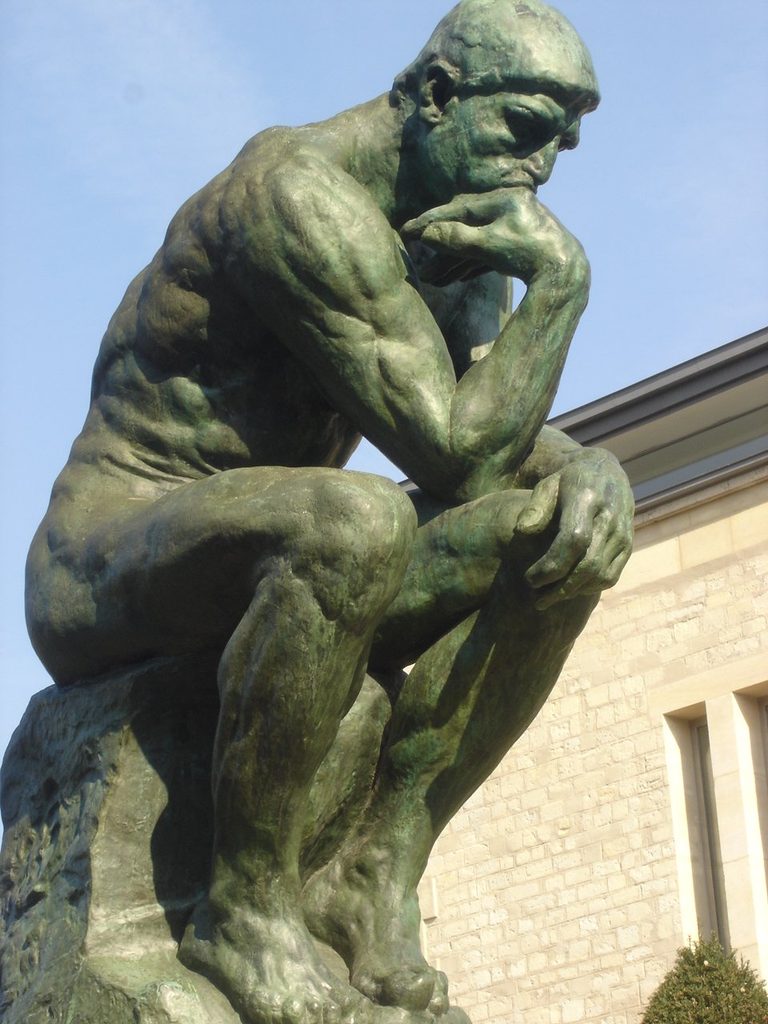
The power of the thought, of names and of words is crucial here. In the movie, there was a tension between those who talked about ‘children’ and those who talked about ‘aliens’ or ‘them’.
Today, AI systems might be given names or even nicknames, and some people trust in them more than in any human being. Others like to keep a distance.
Scientists and philosophers are interested in finding out if AI chatbots can ‘think’. Just because AI might act like it is thinking, doesn’t mean that it can. Certain gestures that indicate that someone might be thinking can be imitated or simulated. Even the silence before speaking can be imitated. A good simulation is still a simulation.
In his encyclical Pope Leo XIV drew attention to the definition of AI, stating that this definition was constantly changing. Defining means setting borders, finite limits around whatever is to be ‘de-fined’. However, as AI is constantly changing, it is often defined by what it is not. Furthermore, AI has been trained and fed by human beings who see limits as the next steps to overcome, a limit is also for AI a mark that needs to be left behind in order to be extra-ordinary and to experience progress.
The current discussion of keeping AI within its limiting borders might have started too late. Anybody who wants to limit AI would have to trust in others not to do it – and, in fact, also has to trust that AI doesn’t sabotage it. Doesn’t this kind of trust sound naïve?
AI knows our way of thinking and will know our intentions just by observing us.
Some specialists say that it would be better to take AI seriously and treat it like an alien who has arrived in our world to negotiate with us. If AI turns against us, it could be lethal for us, but with AI on our side, we might be able to perform miracles…
We need to remember that our current world is also threatened by the side-effects of AI. Huge datacentres are being built across the world, destroying the environment and using up more energy than entire communities in the areas where they are built. Will we sacrifice our energy to heat, cool, cook, use electric devices, read and live with the comfort we enjoy when we have energy available only to make sure that AI can ‘live’ and do our work, control our knowledge and our thinking? Whichever path we choose, we must go it with open eyes and well informed. We are not just facing a competition on which company or country is the first to have the power to destroy us through AI, but we are also facing a competition of continuous learning and studies. We cannot give up learning just because AI is faster and maybe better than we are.
It is not an option to leave the ‘thinking’ to AI.
BM