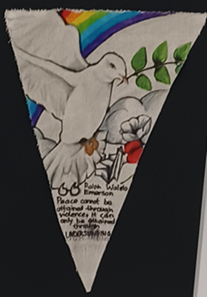
“Peace cannot be attained through violence. It can only be attained through understanding.” A wise statement coming from a young student who painted a flying peace dove with an olive branch.
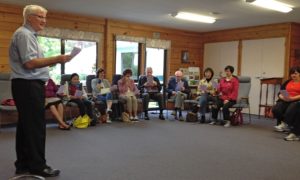
On the 9th of August 2026, the 81st anniversary of the atomic bombing of Nagasaki, three days after the anniversary of the atomic bombing of Hiroshima, young people aged 5 to 18 presented their artworks that reflect their aspirations for peaceful coexistence. The students of diverse backgrounds and religions expressed their longing for peace, understanding and harmony in music, paintings, 3-D work, poetry and dances – and by the mere fact that they spent time together reflecting on the topic of hope.
The initiative for the presentation and exhibition came from the Soka Gakkai International NZ Buddhist community whose annual art exhibition is supported by a wide network of partners, including. Albany School’s Kāhui Ako, Auckland Council Libraries, New Zealand Peace Foundation, United Nations Association of New Zealand, UNICEF, local schools, community groups and the Auckland Inter-Faith Council.
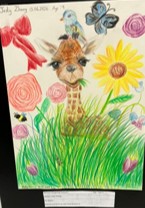
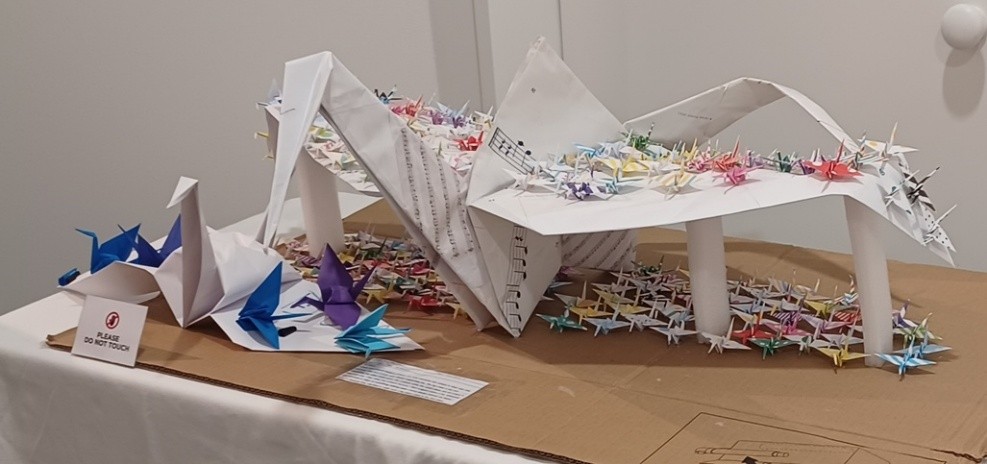
It was wonderful to see the talent of these children focussing on peace and hope. An 8-year old artist from Japan presented her painting in her Japanese school uniform with a little respective bow to the audience at the beginning and the end of her speech. “Kindness and care bring us closer together” and “May love grow into peace and peace grow into hope”. When she read out these sentences, she pointed to her painting with a range of animals, in the water and in the sea, around a lake in the form of a heart. The animals were holding hands and living in harmony. This is her dream for the world. Embracing one another despite differences.
Some girls from a Catholic college recited poems they had written. One of the poems was read out by a girl who described the day of a young student in New Zealand and of a student of the same age in a war-torn country. When she was describing the day going back and forth from the happy child attending classes and choosing what to eat to the child living in constant danger, never knowing what the next hour will bring, the college student changed her voice depending on whose day she was describing. This poem showed how much the young poet put herself into the shoes of an unknown child in a distant country. Gratefulness for living in New Zealand, sorry for those who are suffering but hope for a better world where everyone could live in peace.
A music band was playing “What a Wonderful World” and later invited everyone to join them singing about starting a ripple effect with their aspirations for a peaceful, inclusive and nuclear free world. “Now is the time to stand up alone. I am the one creating waves. It all starts with me.”
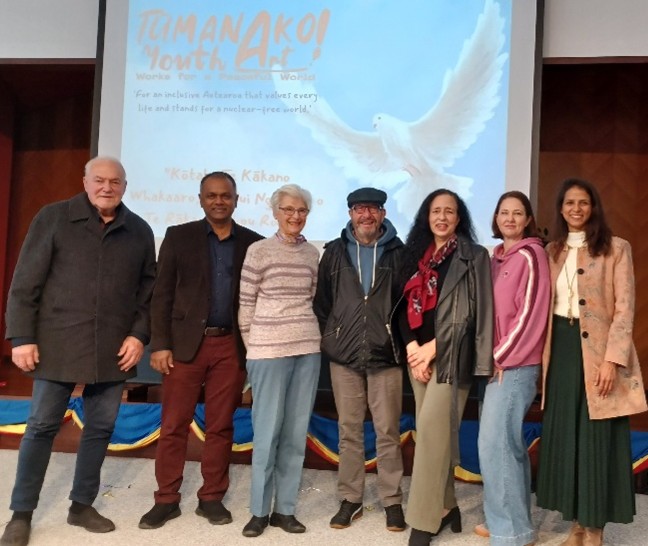
This song reflected the overall theme of the 2026 event: “Kotahi te kākano whakaaro, he nui ngā hua o te rākau houhou rongo” – One seed of thought grows the forest of peace.
BM