There are days and events in history that, when you lived in that time, you will never forget where you were when they happened.
One of these days is the 1st of April 1986. On this specific day, I was in Paris with a friend.
When we were at the Metro, the French subway, that morning, we saw the newspapers with big headlines that reported of an atomic cloud over Germany.
First, we were shocked. Then, we remembered that it was April’s Fool Day. So, we felt disgusted by the bad taste the author of the article was displaying. We didn’t buy the newspaper to read any details, but we considered the headline as a bad joke, and as our friends in Paris didn’t seem to be much concerned either, we forgot about it.
A few days later we returned to Germany.
Both of us lived in the Eastern part of the then Federal Republic of Germany. Only a few kilometres separated us from the border to the GDR and the iron wall – and therefore to the Warsaw Pact countries controlled by the then Soviet Union. Whatever winds and clouds come from the East are usually impacting these regions.
When we arrived, it seemed like everyone was upset. The people didn’t know what to eat, they didn’t know if and when they could go outside or if they had to discard their home-grown fruit or vegetables in their gardens. It was the beginning of April, they were planting and spending time in their gardens, preparing for the harvest later in the year.
It turned out that, on the 26th of March 1986, reactor 4 of the Chernobyl Nuclear Power Plant, located near Pripyat, Ukrainian SSR (Soviet Union) exploded. Wikipedia explains that “The disaster occurred during a test to simulate cooling the reactor during a serious accident in blackout conditions. The operators carried out the test following an accidental drop in reactor power. Upon shutting down the reactor in those conditions, design flaws led to a dramatic power surge. The reactor components ruptured and lost coolant, and the resulting steam explosions and meltdown destroyed the reactor building. This was followed by a reactor core fire that spread radioactive contaminants across the Soviet Union and Europe.”
We learned that even the residents in the region beyond those directly affected by the explosion were not warned neither evacuated until days later. Apparently, they first evacuated about 53,000 people to the Kiev region, the capital of today’s Ukraine. In the following years, more than 350,000 people were evacuated.
Today, the area is still highly contaminated and will not be safe to return for generations to come.
In the direct aftermath, 31 people were reported to have died, and it was confirmed that the rivers were also contaminated with the water taking the contamination further to the joining rivers.
There are estimates that put the death toll of Chernobyl clean-up teams and victims of the accident to as many as 830,000 people.
We might never be able to know the exact number as we can’t always prove the connection between the accident and illnesses that followed even months later.
I remember the concerns in Germany. We were not allowed to eat deer for about two years, mushrooms and any fruit from forests were to be avoided, and then there were confusing messages regarding the vegetable and fruit grown in the region.
There was a radiophobia in Western Europe, especially in those countries that were closest to the Soviet controlled countries. Pregnant women were worried about the health of their unborn babies and many of them were considering abortions. I knew women who were pregnant at the time, and I didn’t envy their situation.
However, what stuck to my mind was that the most dangerous time must have been the days immediately after the accident. This is when people were not aware of what had happened, lived their normal lives and didn’t feel anything.
The Soviet government at the time took several days before they informed their own population and then the rest of the world – and this was in a time of Glasnost, which was supposed to promote openness and transparency.
The Chernobyl disaster was not only a disaster when it comes to the dangers of atomic power plants, but it showed how closely we are connected in times of disasters – disasters don’t stop at national borders. Not even at the iron wall that was considered impenetrable for humans.
Communication across the borders was crucial.
Protests in Germany and other Western European countries grew in which the participants were demanding for all nuclear power plants to be closed down. At the same time, it was awakening. What does it help when you make sure that the power plants on your side of the border are considered safe or are even shut down, while there are power plants on the other side of the border that are so close that they would impact the people on both sides of the borders…?
It was clear that alternatives to nuclear power had to be developed. This is not so easy for crowded countries with millions of people and without major natural powers that could produce sufficient energy to feed the people and provide for the industry.
The disaster in March 1986 shows that we are all connected. If we want to be healthy and safe, we have to work together, overcome our national interests and work together with our neighbours, and actually across the world.
Many countries have banned atomic power in general, but we need to remember that there are also many other looming disasters across the world which we can only prevent if we are working together.
The United Nations Climate Change Conferences, for example, are yearly conferences that deserve attention by media and populations world-wide, but they always need a follow-up.
We need scientists and politicians to work together with and for all the people of the world and to concentrate on the Common Good.
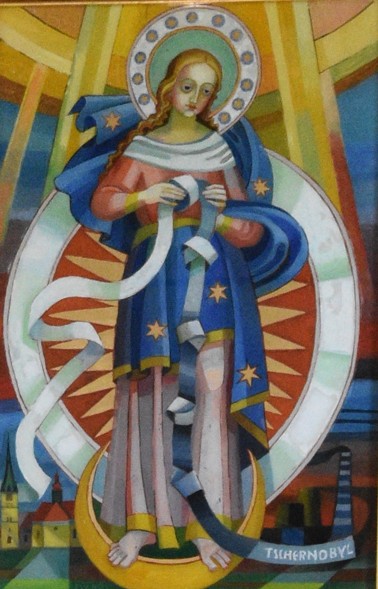
Words without action become meaningless, and can lead to people disengaging when it seems like the wonderful goals and deadlines are turned into illusion. An artist in Austria depicted Our Lady Untier of the Knots with a connection to the knot of “Tschernobyl” (Chernobyl). Let us not forget the victims of natural disasters and remind us that we are all connected…
BM