Catholics are aware of rules and regulations when it comes to celebrating Mass. During the Second Vatican Council (1962-1965) many existing rules were revised. The participants of the Council looked at the roots of the practices in the Church, the origin of some traditions that were introduced in later centuries and which might have led to misunderstandings.
Every now and then it is good to be reminded of the foundations of our practices. Some years ago the Diocese organised “Walk through the Mass” events which were for all Catholics, but this event was focussed on those who are already involved in the preparation of the sacred liturgy.
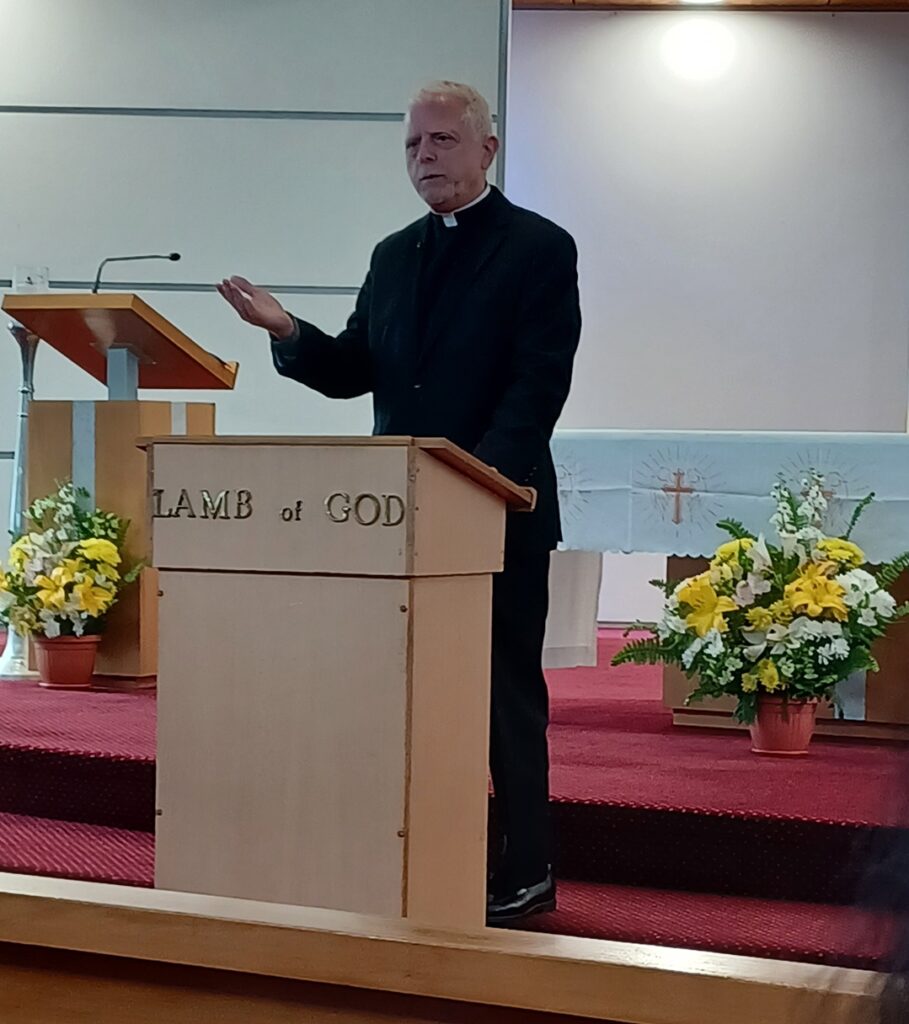
Guest speaker was Fr Paul Turner, a US priest from Kansas City, Missouri, who is also a consultor for the Dicastery for Divine Worship and the Discipline of the Sacraments.
He immediately captured his audience when he started with a disclaimer: “During my whole presentation I will speak American English”.
Turner quoted the Scriptures, some rules and regulations and even Mark Twain. The references were useful and presented in a very gentle and pastoral way. It was helpful to know that he has a website and a blog where anybody can ask questions on Liturgy.
In this sense, the focus was to provide rules and regulations in a nutshell. The main sources of reference were Pope Francis’ Apostolic Letter Desiderio Desideravi – On the Liturgical Formation of the People of God, Sacrosanctum Concilium (Vatican II) and the General Instruction of the Roman Missal.
The presentation started with the preparation for Mass. Pope Francis reminded us in his letter Desiderio Desideravi that “every time we go to Mass, the first reason is that we are drawn there by his desire for us”. Jesus desires us to be at Mass and in order to honour this desire, “every aspect of the celebration must be carefully tended to (space, time, gestures, words, objects, vestments, song, music…) and every rubric must be observed.” (Desiderio Desideravi, #23)
The art of celebrating Mass requires the participation of all the baptised. The celebration includes gestures, words, singing, smells and even silence which is seen as a symbol of the presence and action of the Holy Spirit who animates the entire action of the celebration.
The reminder of faithful participation, the focus on community and harmony and the fact that we are all called to priesthood through our baptism was reiterated several times.
According to the First Letter of Peter (Chapter 2:5,9) we are invited with the words: “Let yourselves be built into a spiritual house to be a holy priesthood to offer spiritual sacrifices.”
Fr Paul Turner explained that the idea of priesthood always includes sacrifice. He quoted St Oscar Romero who dreamt of the day when all baptised would see their work as a priestly work. Anyone who works with honesty, bearing a message of peace and love to others does ‘priestly work’. How can we convey this message to all the baptised? It certainly has potential to change their lives.
As we are called to active participation as a community, it is important to avoid any appearance of singularity or division. At Mass, everyone is called to sing, respond and, in general, follow the practices of their communities.When we do so, we participate at Mass as “Priestly People”.
For the Ministers of the Word it was certainly interesting to know that not only are there general rules about the choice of readings during Ordinary Time but also that the first Reading, the Psalm and the Gospel are usually connected whereas the second Reading is based on a semi-continuous order. In the first Reading God speaks to the faithful whereas Jesus speaks to us in the Gospel. We are recognising Jesus’ presence when we answer the proclamation of the Gospel with the words: “Praise to you, Lord Jesus Christ”.
This answer also acknowledges the reverence to Jesus: when he is addressed, we address him as Lord Jesus or Jesus Christ. An interesting fact mentioned was that it was only the Good Thief on the cross who called Jesus by his name. When hear accounts of “Jesus of Nazareth”, they refer to the human Jesus.
One of the explanations regarding the Liturgy of the Eucharist was around the order and the way of how to receive Communion. The Body of Christ given out at Mass must be from the celebration of that particular Mass. Only if there are more communicants than expected, then the chalice from the place of reservation is to be used. If we compare the Mass to a Eucharistic Banquet, we have to admit that we would certainly expect to receive straight from the banquet…
Many questions were raised, and Fr Paul Turner might not have had much time for himself during the breaks. It seemed like most questions were brought to him when the cameras were turned off. Some questions such as regarding women priesthood in reference to “active participation” or the practice of praying the Rosary up to the moment Mass starts were raised then. Fr Paul Turner answered the question in a friendly, diplomatic way.
What is the bottom line? There are rules and regulations that are created to provide harmony and universal practices in Catholic churches. However, the focus is on the community and helping them to be engaged and actively involved in Mass. Distributing the roles on many ministers helps to give each one a chance to fully and prayerfully participate.
With all this in mind, one of the most inspiring facts was that there were so many people from across the diocese attending the event and showing their interest in learning more about the Mass. The breaks were filled with smiles, greetings, hugs and engaged conversations.
BM