Samuel 16:1.6-7,10-13; Ephesians 5:8-14; John 9:1-41
Light and darkness, being awake or asleep.
In Ephesians we are called children of God – we are children of light and are asked to share this light of goodness, of righteousness and truth.
In the Gospel story, these are also some of the key words. It is about light and truth.
The man born blind would have felt punished from birth. Being born blind meant that he couldn’t work and was depending on the generosity of others. He would have been seen as a burden to his parents and society.
The story starts with an apparently random encounter of Jesus with a blind man. Jesus “saw a man”. The disciples don’t seem to worry about the man but rather about the law. They “use” the man to ask Jesus about a kind of case study. They talk about the man, rather than with him. While the disciples expect Jesus to also talk about the case study, Jesus surprises his disciples. Being asked to judge between two options, Jesus rejects both suggestions. Not only is the blindness not the cause of sin, but the blind man, the man who society looks down upon, the man who is considered a burden to other people is also a means “so that the works of God might be displayed in him”.
Jesus, the light of the world, predicts the darkness, but while he is still in this world, no one needs to live in darkness, and therefore, he decides to heal the man born blind.
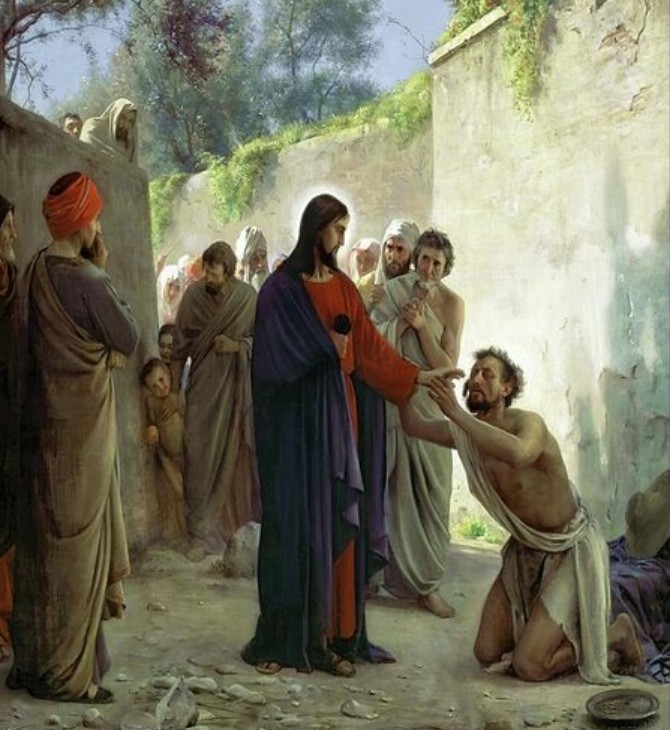
For this miracle, he proceeded in a similar way as His Father in Heaven when he created humans. Instead of breath, Jesus uses his saliva to bind the sand or ground and then places this mud on the man’s eyes. Like when a newborn is washed after birth, the man is told to wash off the mud in the Pool of Siloam so that the works of God might be displayed in him.
The Pool of Siloam was used by pilgrims for ritual purification before visiting the Temple enclosure. The man born blind is cleaned of his disability and will be able to visit the Temple without any stains. A miracle of purification and giving light and new life to a man. He goes home seeing and understanding.
This is where we would expect the story to end. A man is healed and lives happily ever after.
However, this is not so. The miracle is so unbelievable that the people are searching for the kind of truth they can understand. The truth of the accounts is not enough. They don’t understand and so they approach the Pharisees who are supposed to be learned men, but they also don’t recognise the miracle. They are looking for human answers: either the man is not the same man as the blind man or he was never blind and only pretended.
Jesus has given sight and understanding to a man, but the society doesn’t believe in this miracle. The people are trying to find a truth that fits in their limited understanding. Rather than accepting the truth of this miracle, they throw out the man who has said the truth.
This time, Jesus is looking for him. He finds him and is found to believe in Jesus.
He has not only overcome his physical blindness but also his spiritual blindness.
Are we aware of our spiritual blindness?
BM