Acts 2:1-11; 1 Corinthians 12:3-7,12-13; John 20:19-23
In Genesis, when all people still spoke the same language and they thought that their skills and power had no limits, God sent down on them different languages. Babel stands for the audacity to challenge God with the result that the communication among people became harder as they couldn’t work together so easily anymore. A common language unites, but now people were speaking different languages and couldn’t understand each other anymore.
Jesus’ disciples are gathered in a room, celebrating Pentecost and certainly remembering Jesus and longing to be with him. This unity in the room must have been powerful, but also sad and quiet. While reflecting on the past, something like a powerful wind started to fill the room. The wind, the breath of God and the Holy Spirit filled the room. If the disciples’ faith was only a seed planted or a tiny little flame, the wind now blows oxygen into these small flames. As a result, each one of the disciples has a tongue of fire resting on them and they are filled by the Holy Spirit.
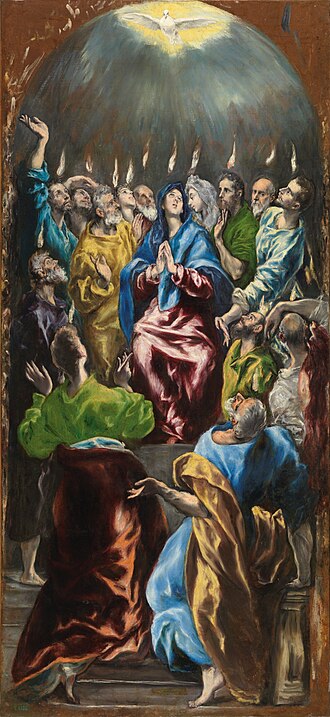
The picture of the tongues of fire and the languages or tongues the disciples now were able to speak is powerful and full of energy.
This is what Elijah might have waited for when he expected God in strong winds or earthquakes. However, God arrived in a small voice to give him His message to convey to the people.
In Acts, the disciples become the actors. They are no longer the ones who simply convey a message but rather are filled with God’s energy to act according to God’s will. They receive the gift of speech from the Holy Spirit.
The sound of the wind from heaven, the noise that filled the house, reaches more than only the disciples. It seems like everyone in Jerusalem is amazed. The disciples, known as Galileans, are now speaking the languages of the people of Jerusalem. Did they leave their secret room and go out and preach in different languages?
The text says that “each one bewildered to hear these men speaking his own language”. It seems like the Holy Spirit filled the people of Jerusalem (at least the ones who were devout) with the gift of listening and understanding.
In Paul’s Letter to the Corinthians, he connects the power and gift of the Holy Spirit with baptism. This passage is the example par excellence for describing the unity of diversity. Everybody is different, and yet everyone is filled by the Holy Spirit at baptism and will hence be part of the one body.
In the Gospel according to John, the disciples are gathering in a room in which they were hiding from potential persecution when Jesus suddenly stands in front of them. Twice he greets his disciples with ‘Shalom’.
Despite the locked door, Jesus has come to them, and he commissions his disciples by breathing new life into them. The disciples are now asked to bring Jesus’ message of peace with his spirit to all people on earth. They receive the power to forgive sins. By forgiving sins, they will bring people back to being part of the unified body of the Church. The disciples, filled with Jesus’ spirit, are sent out. They are commissioned by Jesus to go out into the community and continue his work.
Through baptism, this call is for all of us: bring the Good News and be peace makers.
BM