“Our Kaupapa is Dialogue”
Aotearoa New Zealand is ranking as the 16th most religiously diverse nation in the world. With only about 4.6million people and about half of the population considering themselves as not affiliated to any religion, the other half is religiously very diverse. Even the diversity of Christian churches and denominations is increasing.
How do we address this situation? Can each religious group afford simply withdrawing into their own silos and ignore the other groups?
In a country with a relatively small population and with current threats caused by climate change and political turmoil, it is important to know one’s neighbour.
When Pope Paul VI proclaimed the Vatican II document ‘Nostra Aetate’ 60 years ago, he prepared us for a new way forward. The title ‘Nostra Aetate’ meaning ‘In our Times’ is well chosen – it will never be outdated. While our times today are different to 60 years ago, the reminder in this document has not changed: “The Church reproves, as foreign to the mind of Christ, any discrimination against men or harassment of them because of their race, color, condition of life, or religion. On the contrary, following in the footsteps of the holy Apostles Peter and Paul, this sacred synod ardently implores the Christian faithful to “maintain good fellowship among the nations” (1 Peter 2:12), and, if possible, to live for their part in peace with all men, so that they may truly be sons of the Father who is in heaven.”
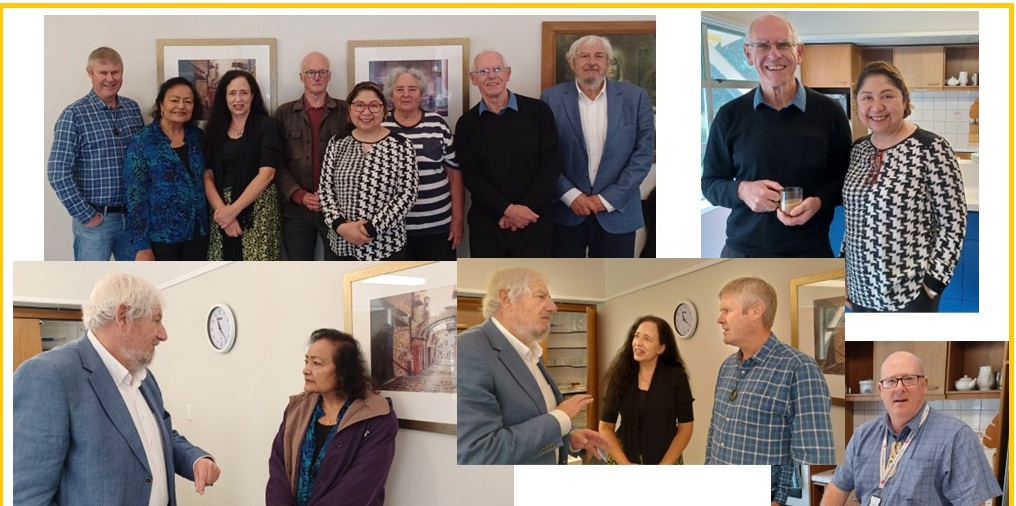
In Aotearoa New Zealand, there are several interfaith councils or groups around the country. The New Zealand Catholic Bishops have appointed one Catholic member to the main interfaith council in each diocese. These volunteers together with Bishop Michael Dooley, the bishop of Dunedin, communicate regularly online, and once a year, they meet in person to exchange experiences, challenges and the joy of working with people of all faiths. During the anniversary celebrations of Nostra Aetate in October 2025, the members organised a webinar, prayer services, talks, candle lighting and much more.
This year, the committee members had invited Paul Morris, professor emeritus of Victoria University, who facilitated a Belieforama workshop together with Beate Matthies. This workshop which is organised through the Religious Diversity Centre (RDC) is usually a workshop to increase one’s awareness of religions and faiths, but was adapted in a way that it was tailored to the participants.
The activities ranged from Religious Literacy tests to case studies and how to react when peaceful dialogues are challenged.
One of the results of interreligious dialogue is that you learn to listen and to accept that others might know more about your own religion than you thought.
Paul Morris gave an example when he analysed Pope Leo XIV’s address at the International Meeting for Peace: Religions and Cultures in Dialogue in Rome. Pope Leo used the word ‘dialogue’ several times, e.g. describing it as a “way of life rather than a tool or technique”, “a journey of the heart that transforms everyone involved, the one who listens and the one who speaks.” – and finally that, “authentic dialogue begins not in compromise, but in conviction – in the deep roots of our own beliefs that give us the strength to reach out to others in love.”
It is important to continue this dialogue not just among leaders of faith but by everyone. Reaching out to our neighbours, those who might be strangers for us, engaging in dialogue and being ready to listen and to learn – these are the first steps to peace and harmony in our communities, our country and ultimately in our world.
BM