The Basilica Santa Maria Maggiore (Basilica of Saint Mary Major) is the fourth of the Seven Pilgrim Churches of Rome that the group from Bamberg visits.
This basilica is the largest Marian church in Rome, and most recently, has become even more important as Pope Francis chose it as his burial place. It was built in the 5th century and is renowned for its connection to the Council of Ephesus, where the doctrine of Mary as the Mother of God was affirmed.
It is therefore not surprising that the security here is very strict and visitors stand in long queues before being able to enter it. The pilgrim groups usually register beforehand and can shorten their waiting time considerably.
When the pilgrims from Bamberg pass the queues, the feelings are mixed. On the one hand there is pure relief and gratitude when one can jump the queue but on the other hand one can feel sorry for those who have already been waiting for a while.
However, once the access to the church has been granted, other administrative tasks cause the group to wait – certainly in one of the most beautiful waiting spaces imaginable.
The goal is to pass through the Porta Santa, the Holy Door, as a group. The bronze door was donated by the Equestrian Order of the Holy Sepulchre in Jerusalem for the Holy Year 2000.
The basilica is impressive. The bell tower is said to be the highest in Rome with about 75 metres, and the gold used for the coffered ceiling is said to be done with gold brought from the Americas by Christoph Columbus.
The triumphal arch at the head of the nave is illustrated with magnificent mosaics depicting different scenes of Christ and the Virgin Mary.
The Basilica Santa Maria Maggiore is sometimes referred to as Our Lady of the Snows, according to the legend of a vision of the Virgin Mary and a miracle involving a snow-covered space on a summer day.
Before this vision, the church was called Saint Mary of the Crib, because of its relic of the crib of the Nativity of Jesus (four boards of sycamore wood brought from Jerusalem by St Helena) which is under the high altar of the basilica.
This is the Chapel of the Nativity, where Ignatius of Loyola is said to have celebrated his first Mass as a priest on 25 December 1538.
Today, in this very crowded space is a bigger-than-life marble statue of Pope Pius IX praying in front of the crib.
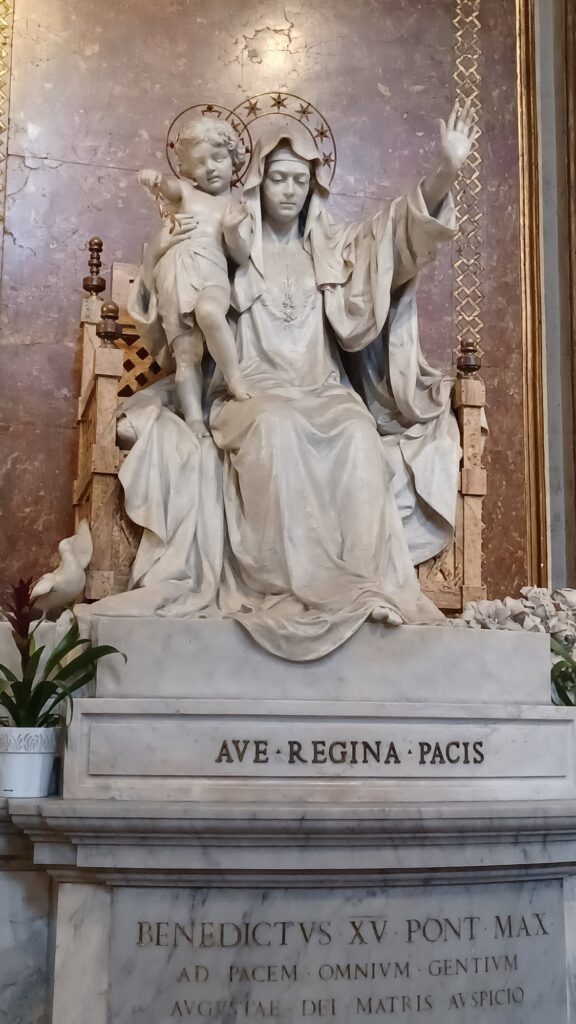
Further beautiful details relating to Mary are the so-called “Lucas Icon” in the Pauline Chapel and the Regina Pacis statue dedicated to Mary, Queen of Peace, by Benedict XV in gratitude for the end of World War I.
Pope Francis’ tomb could easily be overlooked if it wasn’t for the queue of people standing patiently in front of his tomb, saying a prayer, taking a picture and then being asked to move on.
The tomb has been made with materials from the Italian region of Liguria – the region where Pope Francis’ ancestors had come from. It is a simple tomb bearing only the inscription “Franciscus”, and on the wall there is a reproduction of the late Pope’s pectoral cross.
Pope Francis was very dedicated to Mary, and so it is not surprising that he preferred being buried in this basilica rather in the one dedicated to St Peter. Pope Francis once said:
Mary is the road God travelled in order to reach us, and the road that we must travel in order to reach Him.
BM
Series Diary of a Pilgrim