Isaiah 22:19-23; Romans 11:33-36; Matthew 16:18
Accountability is looming. God had chosen Isaiah, the son of Amoz, to speak through him. Just before the account on Shebna, Isaiah had mentioned Babylon, the city that was known for its proud people and that had fallen as well as the damages to the walls of Jerusalem, the City of God.
Shebna was the master of the palace, a high-ranking royal official in the Kingdom of David. It seems clear that Shebna was proud and self-centred, even having a royal tomb built on a rock for himself. He was a kind of authoritarian leader missing the fatherly, the compassionate characteristics and the humility towards God. God sees him and his actions and there is no discussion. God removes Shebna from his position of power and replaces him immediately by Eliakim to whom Shebna’s symbols of authority are transferred. Without the visible signs of power, Shebna has also lost his power and authority.
It is remarkable that Eliakim is not just given the power and authority over Jerusalem and the House of Judah, but that God also lets him know that he is appointed to treat the people as a father would. Authority and power come with responsibility and compassion. God calls him ‘servant’. Eliakim might rule over people, but he knows that he is God’s servant.
When God gives Eliakim the key of the House of David, God places the key on his shoulder. It clearly shows that power and responsibility can be a burden. It should not be taken lightly or used for one’s own gain. As a new leader, Eliakim has to earn the trust of the people.
The account clearly shows that even if a leader believes that no one is above them, that they would escape accountability towards their people, God knows everything. Accountability will come when the earthly leader expects it the least.
God’s wisdom and knowledge is beyond human’s understanding. In his letter to the Romans, Paul writes about God’s infinite mercy despite the people’s disobedience. In the doxology that follows, Paul praises God as the source of everything. With our human minds, we won’t understand the reasons for God’s mercy or any of God’s actions, and we certainly won’t be able to influence God’s decisions.
In the passage of the Gospel according to Matthew, the people have just been asking for a sign from Jesus. They might have thought of a sign like some prophets have been able to show. In one account, the prophet Elijah had asked God for fire to set a sign for those who didn’t believe in the true God and in Elijah being sent by God.
Jesus talks in parables, and even his disciples are not sure what he means. When Jesus reaches a region northeast of the Sea of Galilee, he asks his disciples about what the people think about him. He puts his question in the third person: ‘Who do people say the Son of Man is?’ The disciples seem to accept this reference to the Son of Man without any doubts that Jesus is referring to himself. Given the miracles Jesus has already performed, the answer doesn’t surprise: the people think that Jesus is a prophet. They name him among the most powerful prophets: John the Baptist, Elijah and Isaiah. However, when Jesus then asks his disciples about their own belief, Simon answers first: ‘You are the Christ,’ and ‘the Son of the living God’.
As soon as these words are spoken, Jesus knows that they are beyond human knowledge or wisdom. This answer is proof that God spoke through Simon. It is now clear for Jesus that God had chosen Simon, and so it is God’s decision that he would be called Peter, the rock on which Jesus would build his Church.
God chose Eliakim to receive the key to the House of David, and now God has chosen Peter to receive the key to the kingdom of heaven. The key comes with responsibility and with the power of taking decisions that will go beyond earthly matters.
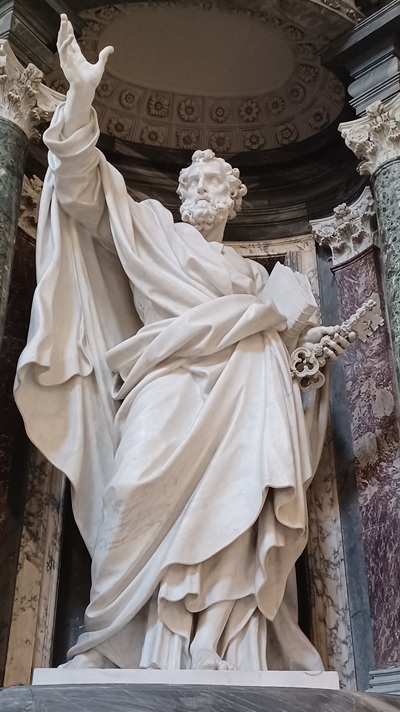
Simon was chosen by God and confirmed by Jesus. His new name is Peter, the rock, symbolising stability and a solid foundation. Shebna was about to build his tomb on a rock, but God prevented it. God chose a new leader and replaced him.
In the Gospel according to Matthew, God decides to have Peter himself as the rock on which the Church of the ‘Son of the living God’ will be built.
All three Readings reflect God’s power, wisdom, mercy and grace. Human minds are not meant to understand fully God’s actions, but God chose human leaders to do God’s will.
The concern about misused authority and the lack of accountability must be taken seriously. God will remove irresponsible leaders eventually and replace them with worthy stewards.
Just like in the Magnifica, Mary’s famous prayer that gives hope to the voiceless and warns those who feel entitled and ignore the suffering of others, that God: “has cast down the mighty from their thrones, and has lifted up the humble.”
BM