Acts 10:34,37-43; Colossians 3:1-4; John 20:1-9
“True life with Christ…” In the Passion Narratives we heard that Jesus’ adversaries were concerned that the body of Jesus might be stolen to then claim Jesus was resurrected. In order to avoid this suspicion, not only was the tomb closed with a big stone, but also Roman soldiers were ordered to guard the tomb.
However, as Jesus said during his trial, his “Kingdom is not of this World”. Guards and stones are signs of the earthly Roman power.
In the light of Jesus’ death and resurrection, Peter meets Cornelius, a Roman gentile, and tells him and his household about Jesus and his ministry which began in Galilee after Jesus was baptised.
Peter praises Jesus’ good work for the people up to his death. He doesn’t refer to the cross, but rather to the tree and then to life, which connects to Adam and the tree of life. When he says that “they killed him”, it is not clear if he refers to the Roman soldiers or the Jewish people who demanded his death. As Peter is talking to a Roman citizen, he might have preferred keeping the accusation open.
The key message, however, is that there is proof that Jesus is alive. Jesus has been eating with the disciples. Dead people or ghosts can’t eat. Jesus is truly alive despite having been killed.
Peter and the other disciples are witnesses and have received the “order” to proclaim the Good News to all. Reaching out to the gentiles, the non-Jews, would have been new for Peter and his friends.
In Colossians, Paul reiterates that it is the belief in Jesus Christ that gives us true life. Jesus Christ has shown us that we can truly believe in life after death. Christ has been revealed.
However, if we see this passage in the context of Acts and how Peter describes Jesus’ good works on earth as well as his call to preach the Good News, we also have our tasks here on earth and can’t just sit idle until we are called to our Heavenly Father.
During the Easter Vigil, we read in Ezekiel about God creating a clean heart in us. With such a clean heart, we will live godly lives and never have to be afraid.
In the Gospel according to John, we hear the accounts that Peter was telling Cornelius about.
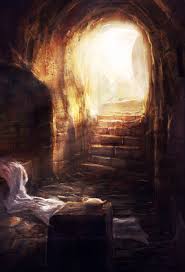
Mary of Magdala arrives at the tomb on the third day after Jesus’ death on the cross. When she arrives, it is still dark. She doesn’t know that Jesus, who said that he was the light, is alive.
She sees the open tomb and doesn’t enter but runs immediately to Simon Peter and tells him and another disciple about it.
As Peter said to Cornelius that “they” killed him, Mary Magadalene now says “they” have taken Jesus away. Who are they? Just as in the conversation with Cornelius, it could be the Romans or the Jewish adversaries of Jesus.
Peter runs to the tomb together with the disciple, “the one Jesus loved”. Who was this disciple? Did Jesus not also love Peter? Some Bible scholars say that this unnamed disciple is a representative of the community of believers. All those who believe in Jesus Christ would then be witnessing the empty tomb together with Peter.
The other disciple reaches the tomb first, but doesn’t enter the tomb and waits for Peter, the leader of the community. However, he looks into the tomb and sees the linen cloths lying on the ground. When Peter arrives and enters the tomb, he also sees the linen cloths on the ground. It is interesting to read that the linen cloth that had been covering Jesus’ head was not on the ground but rather rolled up and in another place. What is the significance of this detail? If Jesus had taken off the cloths himself and had it fall on the ground, why would he bother to roll up the cloth that was covering his head?
When Jesus raised Lazarus from the dead and brought him back to life on earth, Lazarus needed help for the linen cloths to be taken off. Jesus is raised to eternal life and leaves the earthly linen cloth behind.
Both disciples see the empty tomb and the linen cloths left behind, but the Gospel only relates that when the beloved disciple enters, he believes. We don’t know about Peter, but we learn that they come to understand the Scriptures …
Peter is a witness of these accounts and now has the difficult task to spread the news. Together with the beloved disciple and then later the other disciples who meet Jesus Christ, the Good News is being spread around the world. Jesus Christ has conquered death. He is risen – Alleluia!
BM