Genesis 2:7-9,3:1-7; Romans 5:12-19; Matthew 4:1-11
In this creation story, God has created heaven and earth. We don’t know how nor do we know what material God used, but we learn that God is now ‘forming’ or ‘fashioning’ the first human being from the soil of the earth God had created. What sets humans apart from the animals is that God breathed life into the new human, the ha’adamah, the earthling. The first human being receives the breath from God which gives him life and a soul.
Only then, God planted a garden in Eden. According to Hebrew texts, his garden was planted ‘in the place from before’ which is usually translated with ‘east’. What does this ‘place from before’ mean? Maybe before humans had gained knowledge or conscience?
God placed the human being with the breath of life and a soul into this place that God covered with fruit trees. Beautiful trees with edible fruit. The man and the woman had enough to eat – and, as tradition called it later, they were living in paradise. However, humans were created in God’s image. So, God would have known that just living in a beautiful place and eating delicious fruit would not be satisfactory for the new humans. They were also curious. They had a strong desire to know more.
Humans were not only given a soul and life, but also the ability to take decisions and to take responsibility for their actions.
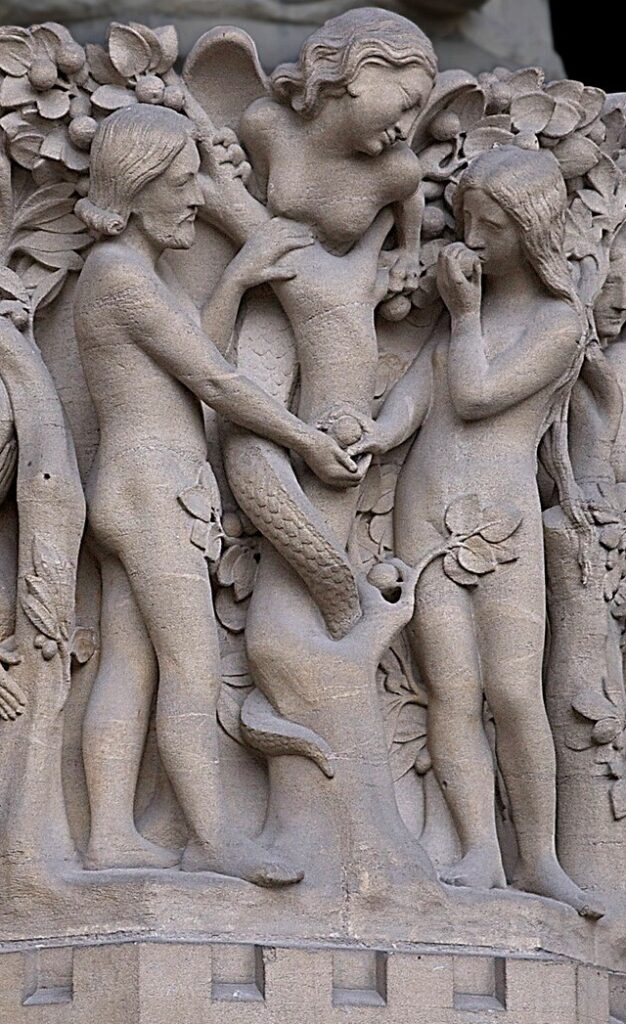
So, when the serpent appears as one of the wild animals, the woman has a conversation with it. The serpent is described as subtle or cunning or shrewd. The serpent is the one that challenges the woman, and through her ultimately the man.
God didn’t tell the humans why they would die if they ate of the forbidden fruit. God didn’t say that the fruit was poisonous. God asked for obedience – was it about ‘blind’ obedience?
Humans have a desire to be knowledgeable but the first humans were asked to be complacent in paradise. God knew that the humans wanted to know more. The serpent was not telling the woman what to do but was sowing doubt in the true reason behind the demand for obedience.
The woman ate of the fruit, gave the man of it, and he also ate of it. It is very likely that the man knew what he was doing. He didn’t ask where the fruit came from. He didn’t remind the woman that they were not supposed to eat the fruit of this tree.
The forbidden tree was in the middle of the garden. They would have passed by it many times and maybe didn’t realise it after a while as they were not allowed to eat the fruit anyways.
We don’t know what type of fruit it was. In early European Christianity, the fruit was depicted as an apple, which, apparently, had to do with the similarity of the Latin word ‘mallum’ for ‘apple’ and the Latin word ‘malum’ for ‘bad/evil’.
God would not have been surprised when the humans challenged the boundaries that were set for them. The humans wanted to know more. They ate of the fruit hoping to gain knowledge – and they realised that they were naked. So, they gained certain knowledge and immediately had to find ways to find a remedy, in this case to cover up their nakedness by sewing clothes.
The new knowledge led to a new situation. A decision had to be taken and the solution needed creativity. The intellectual human being was born. However, the question of knowing good from evil was not solved and is as old as humanity and is still being discussed.
In Paul’s Letter to the Romans Jesus Christ is seen as the new Adam, the one who does right what Adam had done wrong. While the first man was not named in the first Reading, the Hebrew expression ‘Ha’Addamah’, the human formed from the soil, becomes the name of this first man.
While Adam’s behaviour caused everyone to die, another man, Jesus Christ, will cause everyone to live. One man’s fall led to condemnation. One man’s undeserved death leads to righteousness. Adam eats of the tree of knowledge and life, and humanity has to die. Jesus dies on the cross which is made of a tree, and humanity lives.
The comparison of the weak Adam in Genesis and the strong Jesus in the New Testament is further explained in the Gospel according to Matthew.
In Genesis, the serpent was described as a wild animal. In this Gospel, Jesus was led into the wilderness. God had breathed a soul into Adam while Jesus was led by the Spirit – he was filled with the soul and the knowledge of good and evil.
The devil tempts Jesus in the wilderness three times. Each time Jesus answers by quoting the Scriptures. Who knew what Jesus actually said or did? He was apparently alone with nobody writing it down. Jesus knew that he would be put to a test. He prepared well with a 40-day and 40-night-fasting and with prayers.
We know that Jesus knew the Scriptures, and so, it is possible that he quoted the Scriptures when he was shaking off the devil: according to the Scriptures, the devil tempted Jesus with a suggestion, then tried to catch him with a quote from the Scriptures – but Jesus stayed strong, and eventually called the devil Satan. Then, the angels looked after Jesus.
From Genesis with the serpent tempting the woman to the devil who tempted Jesus to finally Satan, tradition has often all three terms (serpent, devil, Satan) being merged into one: the Evil.
The Creation Story of Adam where God forms the first human with soil and breathes life into him, reminds us of Jesus, the Son of God, mixing soil and his own saliva to form a paste that he placed on a blind’s man eyes for this man to see again.
Jesus is healing the blind and is opening their eyes to see – which is also part of gaining knowledge.
BM