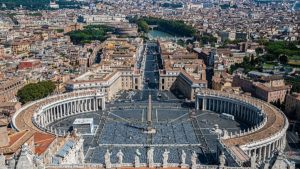
The Vatican Museum, one of the oldest museums of the world, is famous for its sculptures and paintings. The highlight of the museum is certainly the Sistine Chapel.
During the Conclave, the papal elections, the Sistine Chapel is closed as this is the place where the cardinals then gather to decide on a new pope.
When the pilgrims from Bamberg arrive in Rome, they are first not certain if the Sistine Chapel would be open for visitors. The evening before the planned visit to the museum, it is confirmed that the Sistine Chapel would be open.
There are queues in front of the museum but as people are registered by name and apparently for a certain time, the waiting time and going through security is reasonable.
The big group of pilgrims is divided in smaller groups with each having an official guide. One of the tour guides, a man in his forties, starts leading his group first through the Cortile del Belvedere (Belvedere Courtyard) from the early 16th century.
There, in front of a semicircular architectural recess, an exedra, a 1st century Roman bronze Pigna (pinecone), gives the name Cortile della Pigna to the highest terrace; it was apparently an ancient fountain.
In the middle of the upper courtyard, a 20th century piece of art is an eye-catcher: Sfera con sfera (Sphere Within Sphere) a bronze sculpture of two concentric spheres by Arnaldo Pomodoro.
As soon as the group is back in the buildings, it gets difficult to hear the guide and to stick with the group as the hallways are crowded with people. Different tours on different voice channels and in different languages.
It is fascinating to see the huge number of ancient sculptures, but it is hard to keep track of what the guide says and where exactly he points at.
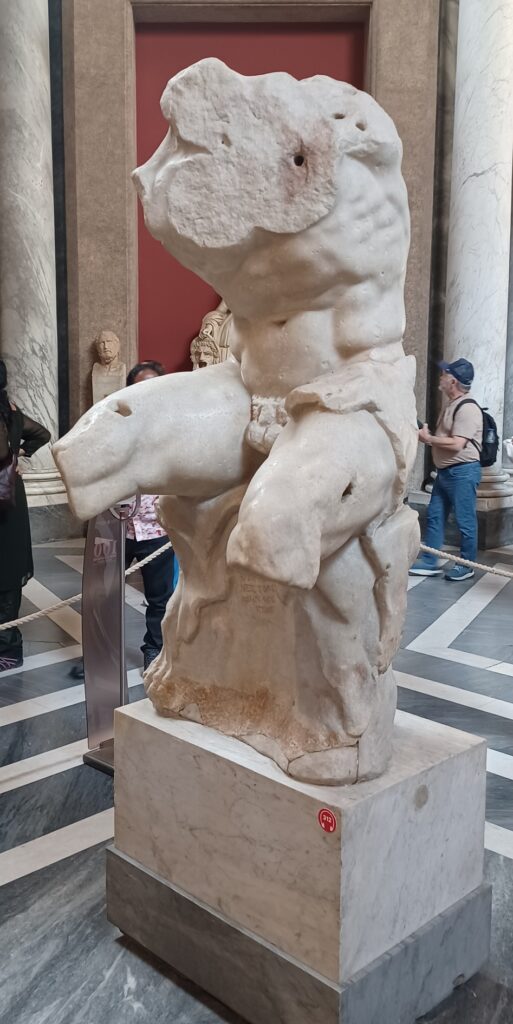
The sculptures that are easy to recognise are the Apollo Belvedere and the Belvedere Torso which is said to have inspired Michelangelo in some of his work. Then, there is the so-called ”Bath of Nero” which was found at Nero’s house. Apparently, it is made from a purple marble called Red Porphyry from Egypt.
Another statue that the guide points out is the one of “Artemis of Ephesus”, the goddess of fertility. Is Artemis depicted as multi-breasted or with bull testicles? Artemis was the daughter of Zeus and Leto, and the cult statue was found at Hadrian’s Villa.
When the guide asks if the group wanted to visit the Raphael Rooms or the Sistine Chapel, the majority opted for both. However, as both rooms are very famous, the question surprises.
The Stanze di Raffaello (Raphael Rooms) were originally intended as a suite of apartments for Pope Julius II. The frescoes are beautiful and have so much to say that it is hard to leave them. The School of Athens is particularly fascinating. There are so many details to admire… Trying to identify the main characters quickly while taking pictures and sharing with fellow pilgrims is not easy.
It seems like it would be worthwhile to spend a day just in these rooms. However, the tour guide pushes the visitors through.
The museum’s guide leaves the group before they reach the Sistine Chapel. There, no photos can be taken. This room is certainly the most fascinating in the whole museum. In addition, given the fact that the cardinals had only left the room a few days before, it seems like there is still a kind of special atmosphere in the room.
However, the room is very crowded, and it is hard to stick to the group. The time is too short to really enjoy the frescoes.
Hurrying from one masterpiece to the next is not pleasant, but maybe that’s the reminder to think of what St Francis de Sales once said:
Never be in a hurry; do everything quietly and in a calm spirit. Do not lose your inner peace for anything whatsoever, even if your whole world seems upset. What is anything in life compared to peace of soul?
BM
Series Diary of a Pilgrim