Not far from Piazza Navona is the church Santa Maria dell’Anima (Our Lady of the Soul). The original church was built in 1350, and the current church was built in Renaissance style by Dutch merchants. The foundation for it was laid in 1500, a Jubilee Year. It became the national church of the whole Holy Roman Empire in Rome and the hospice for pilgrims from Northern Europe.
Inside the church the double-headed eagle, a symbol of the Holy Roman Empire as well as its crest were added in the 19th century. The church is sometimes called “The German Heart of Rome” and is not to be missed for German pilgrims.
The donation box at the entrance carries an old metal sign with the inscription in German: “Opfergaben für die Armen” (Donations for the Poor), and even the signs that tell you not to enter the Sacristy are in three languages: Italian, German and English.
The church is beautiful and is decorated with so many paintings, sculptures and architectural art that it is hard to grasp all of this in an evening just before Mass. However, it is obvious that it has been a burial place for many dignitaries and even a pope.
There is the funerary monument of Cardinal Willem van Enckevoirt (1464–1534), bishop of Tortosa (1522–1534) and of Utrecht (1529–1534) and the resting place of Cardinal Andrew of Austria (1558-1600) who belonged to the House of Habsburg.
The pope who is buried in Santa Maria dell’Anima is Adrian VI (1459–1523) who was the only Dutchman to become pope, and the last non-Italian pope until the Polish John Paul II 455 years later.
Many paintings feature martyrs from Germany and Central or Northern Europe, for example St John Nepomuk and St Benno of Meissen.
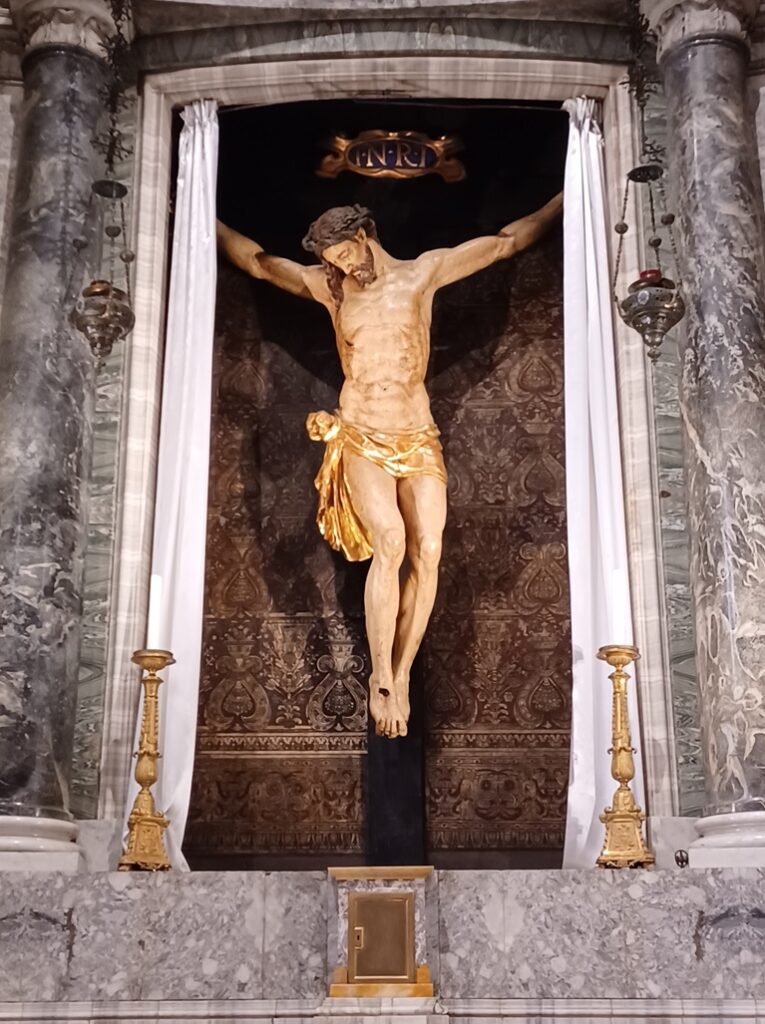
The most famous death and burial, of course, is Jesus’ Passion which is represented by several pieces of art, such as the amazing wooden Crucifix which seems to emerge from a very dark background niche.
There is also an interesting copy of the Pietà by Lorenzetto which is not an exact copy of Michelangelo’s original, as the artist has made a few changes such as the position of Christ’s head.
However, the most moving story and burial might be the one of a 19-year-old pilgrim: Duke Karl Frederick of Jülich-Cleves-Berg (1555–1575), a grandson of Holy Roman Emperor Ferdinand I.
He is said to have come to Rome on a pilgrimage and attended the ceremony in St. Peter’s Basilica to open the Holy Year of 1575. Pope Gregory XIII was so impressed with the young man that he later gave him a consecrated sword and hat, an honour that was otherwise reserved for Kings. However, it was only five weeks later that Karl Frederick died of smallpox while still in Rome. It is recorded that Gregory XIII personally paid the cost of a royal funeral and an enormous funeral procession.
The plague was raging in Italy from 1575-1577 and many cities lost one third of its population due to the disease.
This tragedy might be the reason for another special sign that was added in 2020 – in remembrance of the Covid-19-Pandemic.
While the musicians and the priests prepare themselves for Mass, the pilgrims discover two connections especially to Bamberg:
First, a painting of Heinrich II (St Henry II), who was Holy Roman Emperor and the founder of the Cathedral of Bamberg and then the Diocese of Bamberg in 1007. The painting in Santa Maria dell’Anima shows him with a model of the Cathedral in his hands.
Second, a memorial for Pope Clemens II, the only pope who is buried North of the Alps, and whose tomb is located right behind the cathedra in the Cathedral of Bamberg where he had served as Bishop Suidger.
Germanic history everywhere – it is hard to believe that this church is in the centre of Rome.
The classic organ music and the traditional brass music are played during the Mass, and some of the hymns chosen have been popular for centuries. The voices of the Franconian pilgrims bring life to these songs and the German history of the church.
Considering the many martyrs remembered in this church, St Augustine’s words come to mind:
It is not the punishment but the cause that makes the martyr.
BM
Series Diary of a Pilgrim