St Philip Neri CO, an Italian Catholic priest who lived in the 16th century is said to have been a promoter of a spiritual mission for all and a call to service to others. He played a significant role in the Counter-Reformation, especially within the city of Rome.
In 1553, Neri started the tradition of making a one-day pilgrimage to seven churches in Rome. At each church the pilgrims would pray, sing and listen to a reflection or a sermon.
The Basilica of St Sebastian is one of these Seven Pilgrim Churches of Rome. Another one is the Basilica of the Holy Cross in Jerusalem or Basilica di Santa Croce in Gerusalemme, the next stop for the German pilgrims.
This basilica from the 4th century was apparently first used as the private chapel of the Empress Helena, the mother of the first Christian Emperor Constantine I of Rome.
St Helena had visited the Holy Land and brought several relics to Rome; among others, two thorns of the Crown of Thorns, part of a nail, the index finger of St Thomas and three small wooden pieces of the so-called True Cross.
With the relics being connected to the Passion of Jesus, the basilica has been a very popular destination for pilgrimages during the time of Lent and Holy Week. On Good Friday, the holiest day of Lent, many popes walked barefoot along the road that connected the Archbasilica of St John Lateran to the Basilica of the Holy Cross in Jerusalem to venerate the relics of the Passion of Jesus.
It is interesting to know that this tradition is said to be the origin of the veneration of the cross on Good Friday which is still practiced in Catholic churches around the world today.
The basilica was modified several times and include different styles of architecture. Pilgrims have come for centuries; many of them would have travelled long distances – and not in comfortable buses as it is often the case today.
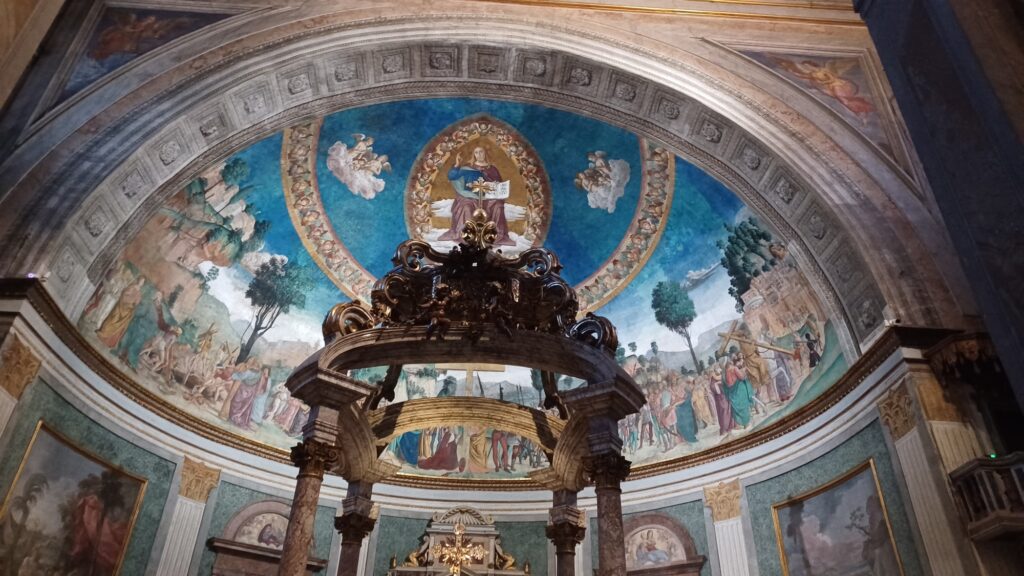
At first glance, the façade of the Basilica, in late Roman baroque style, looks like many other beautiful buildings in Rome. Most pilgrims don’t have the time to study it more closely but rather quickly step inside. The interior is dominated by a beautiful apse with frescoes telling the legends around St Helena and the True Cross. Telling stories in pictures was certainly necessary during the times when literacy was not yet widespread, but the frescoes also overcome language barriers for the visitors from many different countries.
As the basilica is dedicated to the Passion of Jesus, there is also a focus on The Stations of the Cross. While most churches have paintings or carvings of the Stations of the Cross, this basilica is equipped with little bronze statues, each in its own niche and with a description in Italian below. In order to imitate Golgotha, the faithful need to walk up a few steps to follow the Stations of the Cross. In addition to the statues depicting the 6th Station which commemorates Veronica wiping the face of Jesus during his journey to crucifixion, there is also a huge mosaic of Veronica in its separate niche.
After passing the Stations of the Cross and before entering the side chapel of the Holy Relics, there is a beautiful icon of Jesus, and the so-called Jerusalem Cross on the walls is a constant reminder of the name of this basilica and the origin of its relics.
In a rather dark side room, the pilgrims admire the last of the items connected to the crucifixion – the Holy Shroud. It is a natural copy of the original Holy Shroud in Turin and is accompanied by an explanation of each detail in five languages.
Many pilgrims over the years who have visited this basilica might have reflected on the words of St John of the Cross who lived in the 16th century:
Whenever anything disagreeable or displeasing happens to you, remember Christ crucified and be silent.
BM
Series Diary of a Pilgrim