I recently co-organised a pilgrimage to Hokianga. I love the area of Hokianga, which is about 5 hours north of Auckland, New Zealand.
I have done the trip many times, but this time, I went with a small group and was more flexible than on my previous trips.
When we arrived in Rawene to cross the Hokianga by ferry, we realised that we had about 45 minutes to wait for the next ferry. One of the pilgrims told us that a friend of hers had recommended a certain café in Rawene where the coffee was supposed to be delicious.
I had just had a coffee with some breakfast, and so I was not interested in having another one. While the rest of the group entered the café, I roamed around in the area. The café was close to the ferry, and so I was walking alongside the water, when I discovered some steep stairs.
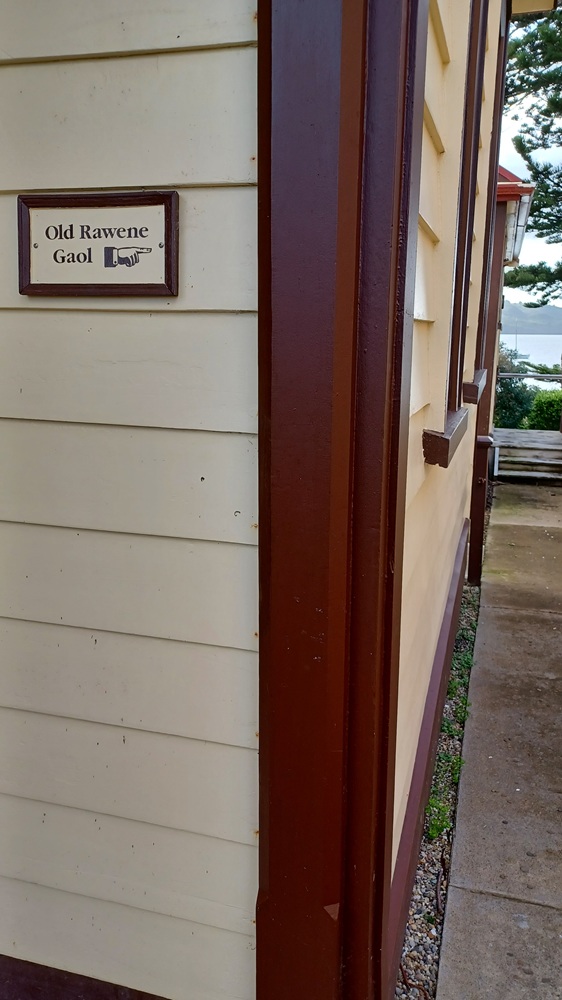
I didn’t know where the stairs would lead, but they seemed to be public stairs. A quick glance on my phone to check the time so that I had an idea when I had to return to be on time for the ferry, and off I went up the stairs until I reached an old building (for the country’s standards). A sign at one of the walls pointed to the “Old Rawene Gaol”. I looked for the entrance, but the door was locked.
Right next to the “Old Rawene Gaol” was another old weatherboard building which was painted in the same beige with dark brown frames around the windows and the doors. The buildings obviously belonged together.
I looked around and found further signs: “Rawene Public Library” and through the window I could read “Rawene Post Office” and “Court House”. Rawene is a historic little town – the third oldest European settlement in New Zealand, and it seemed like I had arrived in the heart of it.
When I was walking around the buildings, I saw that I had reached the main entrance to the area: a beautiful white wooden fence bordering to the side walk of the main road with a free standing wooden sign on the front lawn indicating the public library.
I reached another door on which I saw a sign “Library”. Alas, this door was also locked. What a disappointment, but it was Saturday morning, around 9am, and I didn’t really expect any museum or library in this rather remote area to be open.
I took a picture and was about to turn around and walk back to the ferry when a woman called me. She came over from the other side of the road and apologised for being late in opening the doors.
I could hardly believe what I heard, and I was excited that I was going to be able to visit the buildings.
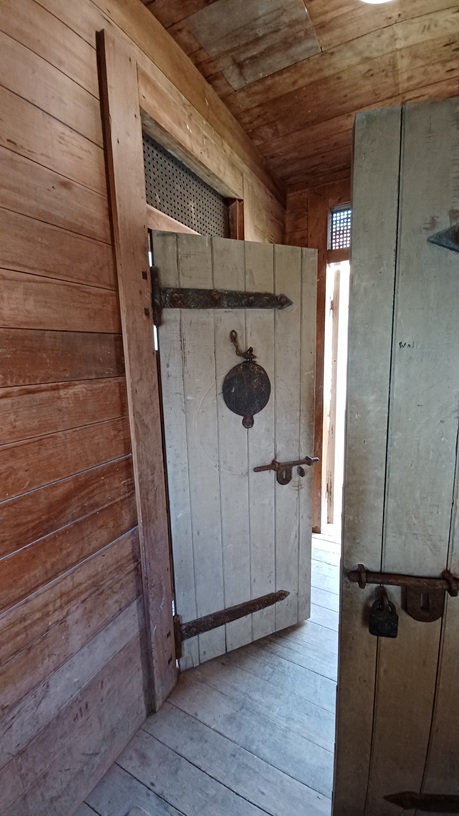
She first took me to the former jail. The heavy door opened to two cells.
I learned that in 1858, Rawene was the administrative centre of the Hokianga, and in 1874 the courthouse was built. In 1879, a request was presented to the Minister of Justice to have a prison for “short sentence prisoners” so that they didn’t have these ‘minor felons’ to travel far away which apparently had led to prisoners escaping. The request also included the idea of using these prisoners as free labour to keep the streets of Rawene clean. This request was successful.
The first records of a prisoner being jailed in Rawene date to the year 1885.
The prison cells were most likely similarly equipped to contemporary cells in many towns in Europe: a straw mattress, a blanket and an ordinary can which was used as the toilet.
In the early days of this jail, the prisoners had often been sentenced for not having paid their debts or fines, whereas in the later years, around the mid-20th century, the prisoners were often locked up for the night to recover from drunkenness before being sent to court in other places.
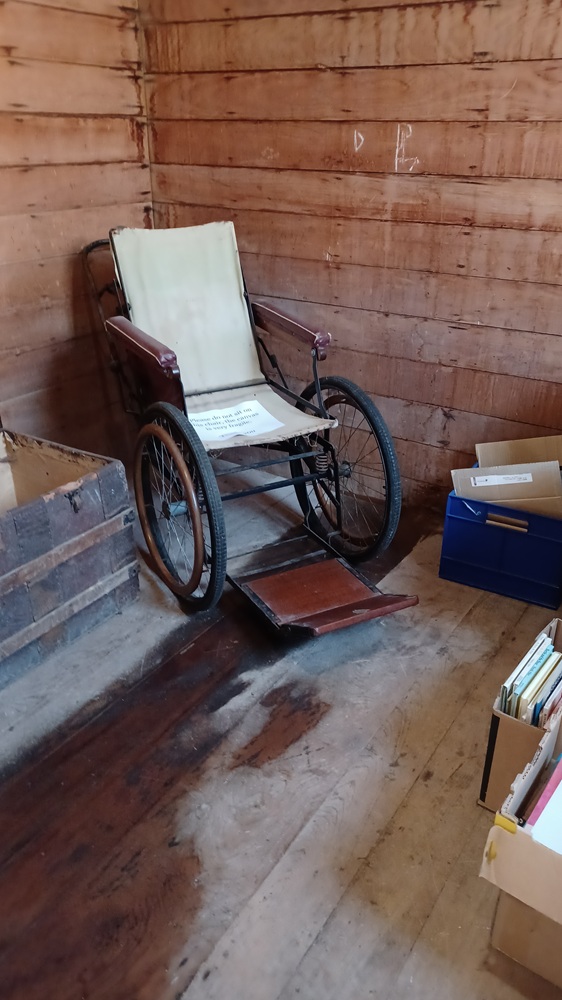
The prison cells, restored by volunteers in the early 1990s, today contain shelves with second-hand books, as well as some historic items such as an old rocking chair and a large wooden chest box. However, the most interesting parts of the former jail are the doors and the graffiti. The doors are equipped with huge locks and with bulls’ eye windows with lids that would slide them closed. The lids were made of steel and almost looked like frying pans.
The graffiti that stood out was written in Māori, e.g. encouraging phrases like “Tihei Mauriora”*. There were also references to the Dog Tax which was introduced in Hokianga in the 1890s and which caused uproar, especially among some Māori residents.
The tax was considered as a British colonial law over Māori autonomy. One of the protesters against imposing a tax on dog owners was Hone Riiwi Toia. Eventually, it led to an armed protest, which was de-escalated especially through Hone Heke Ngapua.
The time spent in these historic buildings went fast, and I returned to the ferry the same way I had come. I was grateful for the experience, and the free time I had in Rawene.
A prison with two cells only, a protest that was contained through de-escalation and graffiti with encouraging messages. Does this still exist today?
BM
* according to Te Aka: ‘sneeze of life, call to claim the right to speak’. Sometimes also translated as ‘I am alive’.