“Compassion is contagious. When you receive it, you want to share it.” These words spoken by Dr Khurram Malik, CEO of Hope Worldwide Pakistan, summarise beautifully the hope that was expressed at the Ahmadiyya Peace Symposium 2025 in Auckland. The theme of this symposium was Persecution and the Moral Responsibilities of the Global Community.
Malik was a trained medical doctor when he arrived in New Zealand as an asylum seeker. As a Christian in Pakistan, he had been marginalised, excluded and persecuted in his home country.
Speakers from the Ahmadiyya community shared similar experiences. Their motto “Love for all – Hatred for none” has spread around the world through their members.
Bashir Khan, National President of Ahmadiyya Muslim Jama’at NZ, called it a “moral imperative” to safeguard religious freedom, equality, justice and inclusion.
The Minister of Police (New Zealand), Hon. Mark Mitchell, warned of complacency. Even though some statistics say that Aotearoa New Zealand is the 3rd most peaceful country in the world, peace is not passive – it is about reaching out. This might take courage. While people who fight for peace might face hardships, we all have to work towards lasting peace which guarantees dignity for all.
“New Zealand welcomes people of all walks of life. This is our moral compass.”, Mitchell said. However, while Freedom of Speech is precious, it should not divide. Peace is built through dialogue, understanding and action. To put it in a nutshell: “Peace is all about Responsibility”
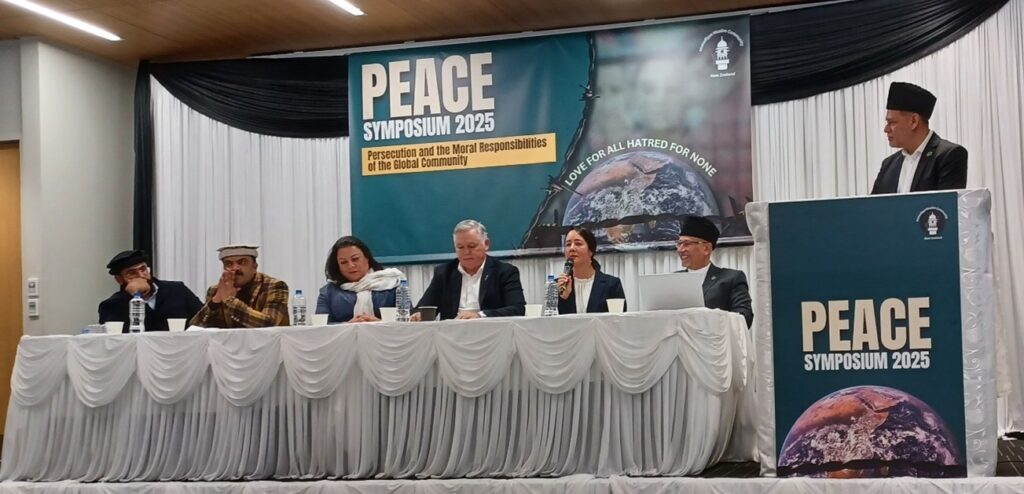
Dr Melissa Derby, Race Relations Commissioner, pointed out that Aotearoa New Zealand was the home of people of many different ethnic groups, faith groups and migrant backgrounds. Therefore, the goal is to reach Social Cohesion. Unfortunately, Social Cohesion is most felt when it breaks down… While we are not all the same and we don’t all agree, we have to act with care, respect and compassion.
The right to peace is a Human Right since 2016 but the mere concept of peace has come under threat.
Across the country, we have many shared values despite our different backgrounds, religions and countries of origin. We all have our stories.
The daughter of Lebanese immigrants, Hon. Rima Nakhle (NZ Member of Parliament Takanini) recounted experiences she and her family have lived through. She shared some wisdom from the Greek philosopher Plato, who wrote about the republic that the family was essentially the cultivating ground for citizenship. The home was the first ground for a thriving republic. So, if there is disorder at home, it will spill over into the city, and from there into the country.
Nakhle reminded public speakers that “when we give a speech, we have a responsibility”.
Imam Asif Munir, a Minister of Religion Ahmadiyya Muslim Jama’at (Waikato), highlighted the importance of continuously working on global peace. While persecution may not be so relevant in New Zealand, there are currently about 300 religious and ethnic groups that are facing persecution, Munir stated. Persecution has always existed. The question is how do we respond?
An advice that is shared by many religions is: If you can’t do anything physically, speak up, and if you can’t speak up, do something spiritually – pray. Everyone deserves a peaceful night. Build a culture of compassion, dignity, respect…
Dr Khurram Malik reiterated in his final remarks that arriving in New Zealand as an asylum seeker has shaped his life deeply. The kindness of volunteers was so important: “A little help, brings a big smile.”
BM