Genesis 18:1-10; Colossians 1:24-28; Luke 10:38-42
Hospitality is a crucial part in most cultures around the world, but especially in cultures where being accepted as a host means survival.
The three men who visited Abraham came during the hottest time of the day. Abraham himself was resting in the shade of the entrance to his tent. Travelling at this time of the day would have made them vulnerable. Before they could ask for help, Abraham ran towards them and asked them to be his guests. He ran. Wasn’t Abraham an older man and the leader of a big household? Why didn’t he ask one of his servants to run towards them or approach the strangers by walking in a normal pace with a welcoming smile. He ran during the hottest time of the day. This reminds me of the Parable of the Prodigal Son in which the father ran towards his son whom he thought lost.
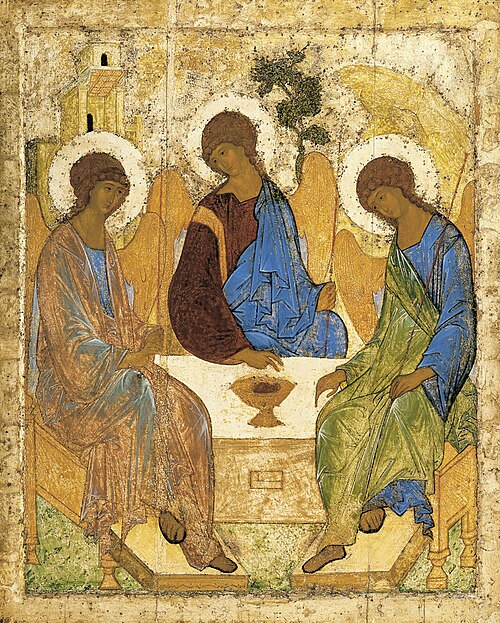
Abraham addresses the three men with “Lord”. How did he know that one of them was the Lord? Genesis doesn’t say that one of the men was different to the other two. It is often interpreted as the Lord with two angels, but could it rather be three angels or the first appearance of the Trinity? The 15th century icon that is attributed to Rublev describes the ‘The Hospitality of Abraham’ but is also called the ‘Trinity’. Three men bringing good news rather than two men bringing bad news to Lot one chapter later.
As the host, Abraham offers the three men a special treatment which includes preparing a special meal: a tender calf. The meal is prepared specifically for the three guests, and Abraham stays close to them and watches them eating. He doesn’t join them but watches them. He is ready to ask for Sarah to serve them more if they would need so.
The men who haven’t introduced themselves were eating. This confirms that they were men – no ghosts or spirits. The Lord appeared to Abraham in the form of human beings. Abraham offers his hospitality and is promised a miracle. Sarah and Abraham, despite their age, are to have a son. Nothing is impossible for God.
Abraham asked the three visitors to be their servant and to host them.
In the Letter to the Colossians, Paul called himself the ‘servant of the Church’ and explains that the Church is the body of Christ. Christ is among the people – this is the mystery.
In Rublev’s icon of ‘The Hospitality of Abraham’, the centre figure is often considered to be Jesus who is ‘among the people’.
The hospitality described in the Gospel according to Luke has parallels to Abraham’s hospitality in Genesis.
In this account, Jesus visits two sisters, Martha and Mary. When Jesus arrives, he is welcomed as their guest. There is no indication that a man is in the household, and so the two roles of hospitality described in the story with Abraham and Sarah are here given to two women: Martha provides the practical hospitality in preparing the food and making the guest comfortable, while Mary keeps Jesus company. She listens to him attentively – does this mean she ‘obeys’ Jesus in the literal sense?
Both sisters are fulfilling their duty and certainly also love of being good hosts. In the absence of a male host, they are sharing the tasks among themselves. Why does Martha rebuke Mary towards Jesus? Would she like to swap with Mary? Is she jealous of her?
Maybe she would just like to sit at Jesus’ side and listen to him, but at the same time she doesn’t want to be a bad host. Her culture demands that she attends to the physical needs of the guest, and so she does what is expected of her.
Mary seems to be so absorbed in what Jesus is telling her, that she forgets her sister, forgets to offer her to help with the chores or to invite her to join her sitting next to Jesus.
Some scholars believe that the ‘better’ part is not the right meaning of the original word in text, but that it should rather be the ‘other’ part. This is very comforting.
We all need to be Martha or Mary at some point. If we continuously run around and try to fulfil all our obligations and please everyone, we will neglect our spiritual nourishment. However, if we are only concentrating on our spiritual nourishment, we will miss out on looking after ourselves and the people around us.
Prayer and action are equally important. They go hand in hand.
Saint Augustine may have put it in a nutshell with his words ‘Pray as though everything depended on God. Work as though everything depended on you.’
BM