Deuteronomy 30:10-14; Colossians 1:15-20; Luke 10:25-37
‘Obey the voice of the Lord your God, keeping those commandments and laws […]’. As these words come from Moses, they have huge relevance. He was the one chosen by God to write down His Laws. The combination of the words ‘obey’ and ‘keep’ in connection with commandments and laws, reveals the original meaning of ‘obey’ – ‘listen closely’. Today, we would simply say ‘obey the commandments’. Listen to the voice of God and do what He has asked you to do.
While being clear that God’s Will had to be done, Moses adds that God would not ask anything that was not possible. God knows our capabilities and while we might tend to think that a burden is too heavy, God will make sure that we can cope with it.
Even Jesus seemed to have had his doubts when praying: “My Father, if it is possible, may this cup be taken from me. Yet not as I will, but as you will.” (Matt 26:39) Jesus knew that God would not ask anything that was impossible.
The power of obedience to God’s Laws is within us, and we can keep our word – we don’t have to reach far to heaven or across the sea. The Word of God is near us.
In the Letter to the Colossians, Jesus is referred to as the ‘image of the unseen God’. Jesus as the Son of God is the head of a body – and this body are we, the Church. Head and body belong together and are held in unity. Jesus is the Beginning and ‘was first to be born from the dead’. He has brought peace through His death on the cross.
The parable of the Good Samaritan in the Gospel according to Luke starts with a man who had studied the Mosaic Laws and who tried to challenge Jesus. Jesus’ response was not as the man expected. Jesus didn’t debate with the man on specific words but rather told him a story.
Who is my neighbour? Who is the person near to me? In many languages, the word ‘neighbour’ already expresses the sense of being close or near to the person.
God has asked us to love our neighbour as ourselves.
When the priest and the Levite saw that there was a wounded man on their way, they avoided being near to him and rather passed by on the other side of the road.
They pretended not to see the person and distanced themselves. Whatever the reasons might have been – they might have been afraid of touching a bleeding man which would have made them unclean according to the Mosaic Laws, or they might have thought that the man was dead and they couldn’t help him anyways. We don’t know.
What we do learn is that the third person who saw the man was moved with compassion. He saw him and felt for and with him. He didn’t hesitate to touch him, to attend to him and use his precious wine and oil for the man who was half-dead. What would have the first two said if they had seen him? Would they have said that he was wasting his wine and oil on a man he didn’t even know?
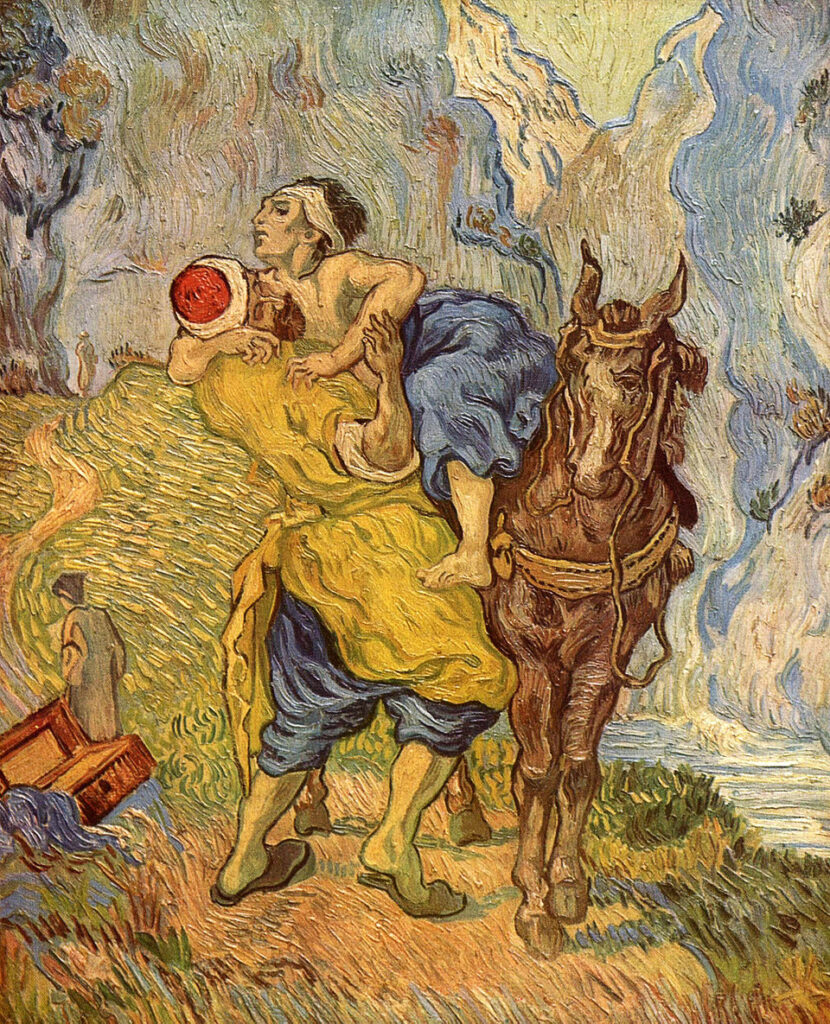
Some paintings of the Samaritan show him giving the victim a drink. However, this is not mentioned in the Scriptures. The Samaritan rather pours wine on the wounds which is likely meant to disinfect and clean the wounds, and afterwards he pours oil on these wounds to help them heal.
The Samaritan might have been on the way from or to a market where he would have sold the precious wine and oil. He didn’t hesitate to give generously of what he had, and his care for the wounded man even goes further as the Samaritan takes him to an inn and pays the innkeeper in advance to continue with the care.
The man who showed compassion was a Samaritan. A man who was at the margin of the society in Jesus’ time. Only a few chapters before the parable of the Good Samaritan, Luke tells another story of a person who is at the margin of society. It is a woman who ‘had lived a sinful life’ who pours oil on Jesus’ feet.
The care and love of your neighbour doesn’t have anything to do with your belief or how well you are respected by others, but it has to do with the action of showing loving kindness and compassion to those around, to all neighbours.
The man who challenged Jesus had to admit that obeying by the Law is more than a lip-service. It means that you are called to act when it is uncomfortable, dangerous or costly for you – but as God doesn’t ask of us anything that we can’t do, His Law doesn’t just say ‘love your neighbour’ but rather ‘love your neighbour as yourself’. We need to love ourselves so that we can love our neighbours, and we need to ‘suffer with’, i.e. show compassion, for those who need our support.
BM