Located about 25 kilometres from Vatican City is Castel Gandolfo and the Papal Summer Residence.
Built in the 13th century as a private palace, it was in 1626, that the first pope visited the town. Pope Urban VIII must have fallen for its location. He had the papal palace and the adjoining Villa Barberini built.
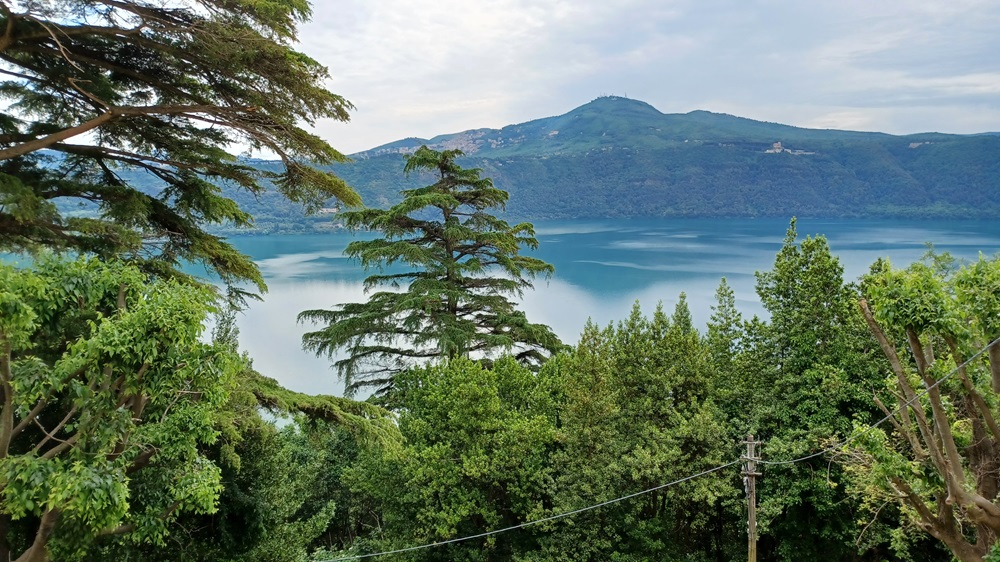
The drive up into the Alban hills is beautiful. When there are no houses in sight, the landscape gives the impression of being in Bavaria. No wonder that Pope Benedict XVI loved it here. It must have felt like home for him. From the picturesque town or from the castle, the view down to Lake Albano lets one forget that the busy city of Rome is only about half an hour away.
While the landscape would have felt like home for the Bavarian Pope Benedict XVI, this was not the case for Pope Francis, the former Archbishop of Buenos Aires. In fact, Pope Francis apparently never stayed overnight in the residence, and in 2016, he opened the palace to the public for viewing. So far, Pope Leo XIV has not announced his plans for the palace.
The buses park in a bus depot, and the pilgrims walk up the hill where they arrive at a beautiful Italian marketplace that is dominated by restaurants and tourist shops. By entering the grounds of the apostolic palace, the pilgrims officially leave Italy and are on extraterritorial Vatican grounds. Here, the pilgrims wait in the courtyard while they are divided into two groups with each a tour guide.
The courtyard is a great place to wait. This is an open museum of popemobiles. The signs at each car provide more information: a BMW 7331 (1979), used by Pope John Paul II, a Piaggio APE 400, used by Pope Benedict XVI (2008), a Land Rover Santana (1983), and a Mercedes Benz (1997) used by both Pope John Paul II and Benedict XVI.
It seems like the big statues of St Peter and St Paul are guarding these vehicles from two corners of the courtyard.
The tour guides take the pilgrims first to the Barberini Gardens. Pope Urban VIII who had the papal summer residence built in the 17th century, belonged to the Barberini family.
While many churches in Rome connect the visitors to Christian lives and beliefs through the centuries, the apostolic palace has been a private and yet official home for popes for about 350 years. Going through the rooms of this palace, it feels like visiting a royal castle that has been turned into a museum – and yet, it is open to the public only since 2016. We still remember news pictures and videos recorded in these rooms.
It is fascinating to see so many papal coats of arms on walls and furniture. The guide explains that these coats of arms are part of anything purchased or built during a certain papacy. So, instead of having a number for the year, there is a coat of arms. They even feature on flowerpots and radiators.
Some rooms are like art galleries with paintings of the pontiffs over the years. An eye-catcher is the beautiful painting of Pope Leo XIII as it is amazing to see the resemblance between him and his successor Pope Leo XIV.
The pilgrims are shown personal items of past popes: papal slippers, writing sets etc. as well as many symbols of a monarchy, such as thrones and uniforms of guards. Two rooms that have become famous in 2013 are one of the meeting rooms and a chapel where Pope Francis and Pope Benedict XVI met and prayed in the presence of reporters.
Every pope who resided in this palace, left a personal note, and some rooms look so authentic that it seems like the pope would come home any minute. In Pope Benedict XVI’s office there is even a little Bavarian flag in the pencil holder. The Franconian pilgrims are happy to see that it is a flag with the greater coat of arms of the Free State of Bavaria as it includes the coat of arms of Franconia, the Fränkischer Rechen (Franconian Rake).
The tour through this palace ends with a glimpse into the times of World War II. In 1944, the palace and its grounds were then opened for about 12,000 people who took shelter to escape from Allied bombing raids. Children were born here, and the pope’s private apartment was turned into a nursery.
Shortly after arriving at the papal summer residence of Castel Gandolfo on 28 February 2013, Pope Benedict XVI said to the crowds awaiting him:
“I am happy to be here with you surrounded by the beauty of creation and your friendship that warms me. […]
I am a pilgrim who is beginning the last part of his pilgrimage on earth.”
BM
Series Diary of a Pilgrim