The Campo Santo Teutonico (Teutonic Cemetery) is a burial site right next to St Peter’s Basilica and is owned by the Confraternity of Our Lady of the German Cemetery.
As an additional item on the pilgrimage schedule, most of the Franconian pilgrims would not have expected to visit this special site.
Given the location, it is not a surprise that the pilgrims have to pass security checks again. This time, they could see police and the famous Swiss Guards.
There are Eastern Church leaders who arrive from behind the basilica. Later, the pilgrims learn that the Pope had just had a special audience with them.
The police inform the leaders of the pilgrim group that only smaller groups of 20 pilgrims could go through the checkpoints at a time. The first 20 pass through, but as the leaders are still organising for the next groups to go through these checkpoints, those first ones are approached by one of the Swiss Guards. Surprisingly, he hardly speaks any German. He calls another one who comes and answers with his typical Swiss accent. The Swiss Guard in his 16th century uniform does a few phone calls on his mobile phone which looks like two different worlds coming together. The pilgrims have to wait until their leaders arrive to clarify that a visit to the Campo Santo Teutonico is planned.
The group is now welcomed by the Swiss Guards. This feels quite special.
The cemetery is an extraterritorial property of the Holy See and is located on the site where the Circus of Nero once stood and where, in the year 64, early Christians were martyred. Pope Leo III is said to have given the land to Charlemagne for a hospice for Germanic pilgrims. According to the information in the Campo, the place was first mentioned in 799 as “Schola Francorum”. The chapel was dedicated to Our Lady of Sorrows in 1500.
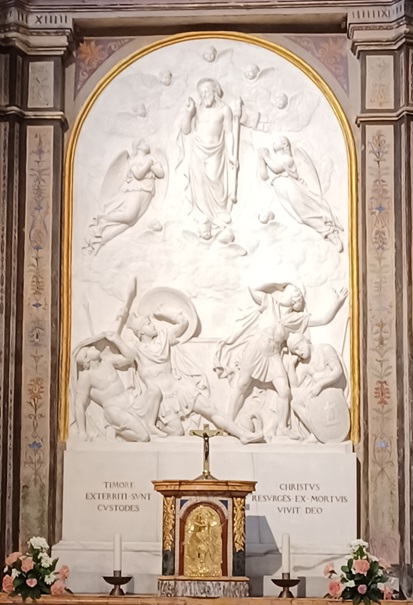
In the chapel, there are many skulls and skeletons. Some are in marble and of beautiful artwork, yet sad to see. Passion, death and Resurrection dominate inside the chapel. In the cemetery, the tombstones point to clergy, nobility and pilgrims from German speaking countries who died in Rome. Some burials only took place a couple of years earlier.
One of the tombstones remembers a famous Franconian mathematician, astrologer and astronomer: Regiomontanus who was born Johannes Müller von Königsberg (1436 –1476). It is said that, in 1475, Regiomontanus was called to Rome by Pope Sixtus IV to work on the planned calendar reform but sadly died only a few months after reaching Rome.
The Franconian pilgrims enter the cool chapel and remember all deceased in prayer, while listening to a reflection and by singing a German hymn.
The site is not only called “Campo Santo”, but it also feels like a “Holy Field”. With the beautiful plants, it is a bit like a garden, but some of the tombstones are a reminder that life can sometimes end abruptly.
Regiomontanus recommended in his book De Tringulis Omnimodis:
You, who wish to study great and wonderful things, who wonder about the movement of the stars, must read these theorems about triangles. Knowing these ideas will open the door to all of astronomy and to certain geometric problems.
BM
Series Diary of a Pilgrim