The square around the Lateran Palace is amazing: the Basilica of the Holy Cross in Jerusalem, the Basilica of St John Lateran, the Porta Santa, the Scala Santa and the Lateran Obelisk.
Pilgrims and tourists are chatting, pointing to these buildings, taking pictures, crossing the streets and merchants trying to sell souvenirs…. If Rome didn’t have so many holy places, it would be appropriate to declare this area a pedestrian zone.
Most of the drivers would be used to people crossing the road without watching – or watching the wrong way if they come from a country where people drive on the other side of the road.
The group follows the tour guide but doesn’t know where to look first. There is a point where many pilgrims stop trying to orientate themselves but rather follow the long tour guide stick with the blue flag fixed to it.
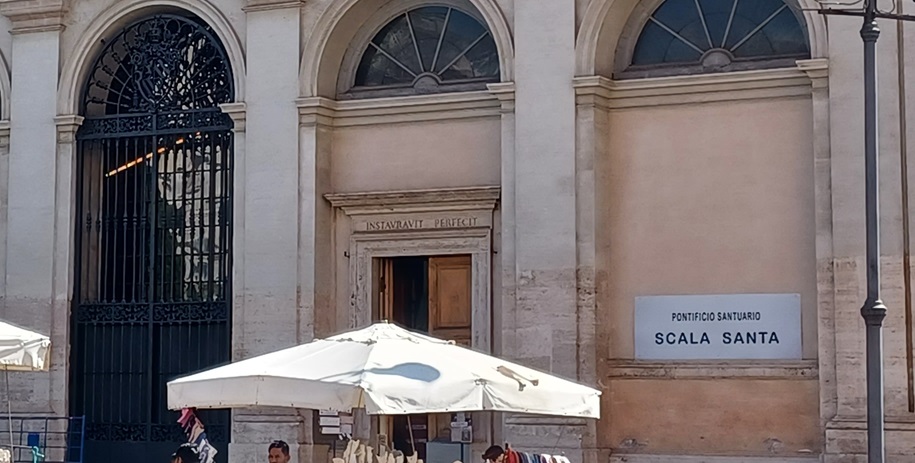
Then, it feels like all of a sudden, the group stops in front of another historic building. With the merchants gathering in front of the building and people trying to sell souvenirs, the rather small sign “Scala Santa” at one of the decorative corner windows can easily be overlooked.
Once the group is gathered again, the tour guide tells the pilgrims of the importance of this building before entering with a soft voice, asking the pilgrims to be very respectful and silent.
What is so special about these Holy Stairs that are a set of 28 white marble steps?
The main entrance to the building leads to these marble steps but the German pilgrims enter through a staircase that is separate from the main entrance. The top of both staircases are on the same level. When the pilgrims reach the top of their staircase, they look down to the Holy Stairs and see some faithful on their knees.
Out of respect for them, most of the pilgrims don’t dare to take photos of these faithful.
The building was originally called the Pontifical Sanctuary of the Holy Stairs and was part of the Lateran Palace. According to tradition, the Holy Stairs can only be climbed on one’s knees.
The reason for it is that it is said that St Helena, the mother of Emperor Constantine I, had brought these stairs from her visit to Jerusalem in the 4th century. They are said to be the very stairs that Jesus walked on his way to Pontius Pilate. Therefore, they used to be known as Scala Pilati (“the Stairs of Pilate”).
The devotion of climbing the Holy Stairs has been performed for centuries, and popes have granted indulgences for it.
The pilgrims from Germany know the story of Martin Luther, then still an Augustinian monk, climbing the steps on his knees in 1510. As it was required, he repeated the “Our Father” on each step. It was said that by doing this, one could “redeem a soul from purgatory.” But apparently, when Luther arrived at the top of the staircase, he could not suppress his doubt, saying “Who knows whether this is true?”
Climbing the Holy Stairs is a way to relieve burdens for some, but for someone like Luther, it was a moment of doubt.
No time to further ponder on the meaning of these stairs. The pilgrims from Bamberg are asked to get back to the Lateran Place and walk past the Basilica of St John Lateran. There, a huge obelisk is dominating the space. It is the largest standing ancient Egyptian obelisk in the world, known as the Lateran Obelisk. It weighs an estimated 455 tons.
Climbing Holy Stairs or visiting the Lateran Place might be considered extraordinary efforts for the faithful, but Pope Francis said that
Holiness doesn’t mean doing extraordinary things, but doing ordinary things with love and faith.
BM
Series Diary of a Pilgrim