Reflection on the Readings for 02 Feb 2025:
Malachi 3:1-4; Psalm 23(24):7-10; Hebrews 2:14-18; Luke 2:22-40
Be prepared! The Lord might enter the temple when you don’t expect it.
Similar to the bridesmaids who were waiting for the groom to arrive (some were prepared and others weren’t) today’s Readings are about being ready for the Lord’s arrival.
The Book of Malachi was written shortly before Nehemiah’s arrival in Jerusalem (445 BC), and it contains criticisms of those who believe that they are chosen by God and therefore nothing bad could happen to them. The name Malachi means “My Messenger”.
The messenger makes it clear: even though one is seeking and waiting for the Lord to arrive, they might not be ready when he actually comes. After all, how could you recognise the Lord if you have a fixed idea of when he comes and how he looks like?
The messenger Malachi points out that the sons of Levi who know the Law of Moses, would first have to be “refined and purified” before they are allowed to make offerings to the Lord.
This sounds almost like the warning from Noah. Noah asked for people to repent and warned of a flood where only the righteous would be saved.
Purifying through washing or through burning. Water or Flame. Separating those who abide by the Laws from those who don’t.
Noah was described as a “righteous” man. Joseph, Mary’s husband, was also described as a “righteous” man.
As a righteous man, Joseph followed the Laws given by God. When Jesus was born, he and Mary presented Jesus to the temple – just as it was the Law and the practice for all descendants of Abraham. No exception for Jesus. Jesus lived the life of a human with the same rules, regulations and temptations.
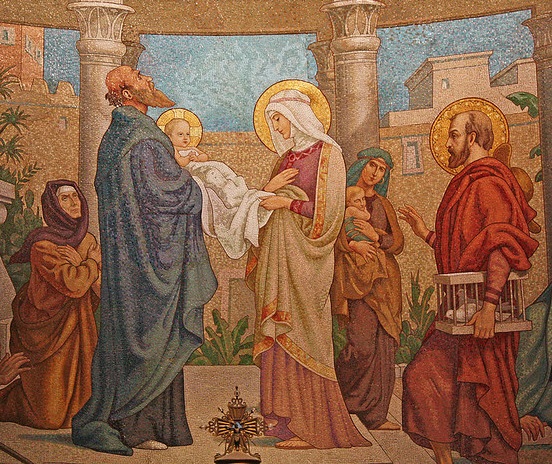
In the Gospel according to Luke, the warnings of Malachi are reflected in a positive way: Simeon and Anna were both in the temple, waiting patiently and were immediately ready when they saw Jesus, recognising him – even though they most likely would not have expected the Lord to arrive as a baby, a little child that was to be consecrated to God.
Malachi mentioned the process of purification. Jesus is brought to the temple for the presentation, the purification ceremony. There, Simeon recognises him and calls him “Master”. How did he know? Simeon was, just like Noah or Joseph, a “righteous” man. He was therefore prompted by the Holy Spirit.
Simeon is excited but his prophecy sounds dark: Jesus is “destined for the fall and the rising”. He mentions a sword and piercing… The crucifixion of Jesus comes to mind. The rising and falling also reminds me of a man with a similar name – Simon, who was ordered to help Jesus carry his cross…
Simeon is an example of a prophet: faithful, righteous and inspired by the Holy Spirit.
Anna is his female counterpart: she was married for 7 years, has been living in the temple since her husband’s death – a faithful woman. When she saw Jesus, she was 84. This is a very advanced age for Jesus’ time. However, if she was married at the traditional age of about 14 years, she would have lived in the temple for 70 years. Seventy has a sacred meaning in Scripture that is made up of the factors of two perfect numbers, seven (representing perfection) and ten (representing completeness and God’s Law).
The Readings remind us that we are not in control of the way nor the time when the Lord arrives. So, we need to be ready at all times.
BM