“In our times”… (Nostra Aetate) – a title that doesn’t really tell us anything about the content of this encyclical. However, it also makes the document timeless. The content was relevant in the times of Vatican II (1962-1965) as much as it has been relevant ever since.
Interreligious dialogue is nothing new. There have always been people who have communicated with people of other religions, and some were more famous than others. In times of conflicts, the openness to this kind of communication becomes more challenging as was the encounter between Francis of Assisi and the Egyptian Sultan al-Kamil during the times of the Crusades.
The Second Vatican Council, Vatican II, was a post-war council. When Pope John XXIII opened it in October 1962, the world was at the brink of a third World War within half a century. The Cuba Crisis reminded the world of the fragility of a peace that was not even called as such but was rather known as “Cold War”. The Europeans were still rebuilding their cities and their lives, and several West-European countries were flooded by millions of refugees and displaced people from Warsaw Pact countries. The fear of another war was real and the longing for peace was strong.
This was the time of the foundation of Nostra Aetate, the “Declaration on the relation of the Church to Non-Christian Religions”. The document was revolutionary for Catholic Teaching. Instead of insisting that Catholicism was the only true religion, the only way to God, it states: “One is the community of all peoples, one their origin, for God made the whole human race to live over the face of the earth.”
Nostra Aetate, promulgated by Pope Paul VI on 28 October 1965, is an invitation to all of us to reach out and not to be afraid of meeting people of other religions.
In Aotearoa New Zealand, and particularly in Auckland, according to official census data from Stats NZ, the Christian population is declining while the religious plurality is increasing.
In 2015, for the 50th anniversary of Nostra Aetate, Rabbi Fred Morgan, a Jewish professor, then based at the Catholic University of Melbourne, Australia, was visiting the country and gave talks about his work to overcome prejudices between Christians and Jewish people.
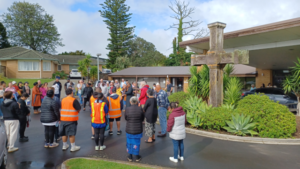
This year, for the 60th anniversary, I was part of a range of events in Auckland and Hamilton, and a webinar with and by the members of the New Zealand Catholic Committee for Interfaith Relations (NZCBCIR).
However, it seems like many Catholics in the country are mainly inward thinking. They are so focussed on their own Church communities that they seem to have no time for reaching out to non-Christians. What is the reason for this apparent indifference? Are the Catholics taking the results of Nostra Aetate, e.g. the opportunity of visiting other places of worship, for granted? Are they feeling uncomfortable when mixing, mingling and sharing with people of other faiths – or have they moved back into the comfortable pre-Vatican II attitude of staying within their own Catholic bubbles?
Withdrawing from the wider community is dangerous. Misinformation and prejudice can spread like wild-fire, and with so many conflicts, wars and political tensions, people of faith could do so much good work together.
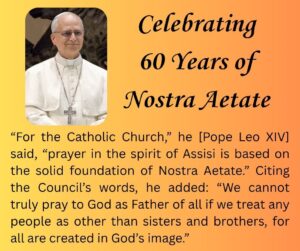
Pope Leo XIV reiterated during his recent visit in Istanbul that it was important to build bridges and not let religion be used to justify wars and atrocities, and in a different address, delivered in the presence of Christian, Jewish, Muslim, Buddhist, Hindu, and other religious representatives, the Pope recently renewed the Church’s call for reconciliation, dialogue, and fraternity among all peoples.
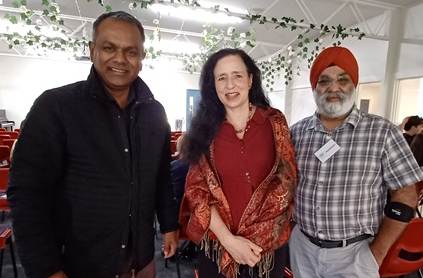
Nostra Aetate, the call to interreligious dialogue, is not just a tool for peace, but it needs to be part of our DNA. Building relationships with members of other faiths takes time and constant effort. These relationships are like bridges that need to be used and maintained. They are not meant as a historic award that needs to be polished every 10 years to celebrate its existence and then hidden away again and barely mentioned. It is important to make sure that Nostra Aetate is part of the curriculum at Catholic seminaries and that it is taught as part of the standard Catholic education – currently, most priests don’t ever mention it in their Homilies.
A document as profound and transformative as Nostra Aetate should not be gathering dust. We should not be asking whether the questions it raises are still relevant; we should be asking how we can reintroduce and reincorporate its teachings into the life of our faith.
Seyyed Hossein Nasr, a professor of Islamic studies at George Washington University, expressed a similar sentiment at a conference marking the 50th anniversary of Nostra Aetate in 2015: “There is a great battle going on in the world between dark and light, and on almost every issue we are on the same page. It’s time for us to understand that we are in the same boat and that we can cooperate.”
In the Christian world, the prayer most frequently prayed is the Lord’s Prayer or “Our Father.” It is the prayer that Jesus taught us to pray. Its central petition is: “thy kingdom come, thy will be done, on earth as it is in heaven.” It is hard to imagine that in heaven there would be wars over how to worship God, or that some children would be starving while others live in mansions.
So, let us use this 60th anniversary of Nostra Aetate to reimagine interreligious dialogue not as a theological construct but as a prophetic call to come together in unity and peace and begin to create God’s kingdom of heaven here on earth.
BM