2 Samuel 5:1-3; Colossians 1:12-20; Luke 23:35-43
David is being anointed and ‘all tribes’ show their support. The journey to this moment was not an easy one for David and the tribes. However, it was God who chose David, a former shepherd, to be the shepherd of God’s people and to lead them. Leading as a shepherd means that David has been asked to take care of God’s ‘flock’: making sure that they are protected and can find green pastures to nourish themselves. The relationship between the shepherd and the sheep is based on trust.
The kingdom of the God’s Son. This kingdom brings us light as it will lead us to freedom through forgiveness. What a difference to the traditional concept of a king who would rather restrain his subjects’ freedom.
This is possible through the choice of the king. Just as David was chosen by God, Jesus was also chosen by God – Jesus, the Son of God, was also born into the royal family of David.
David was anointed by ‘all tribes’ – unanimous consent. Unity. Jesus, created in God’s image, reaches beyond ‘all tribes’. He unifies everybody, everything – all creation. He is the head, the leader of the Church, but also part of the Church. The head can’t act without the body, and the body can’t act without the head.
Jesus has gone before us, in his suffering and in his rising from the dead…
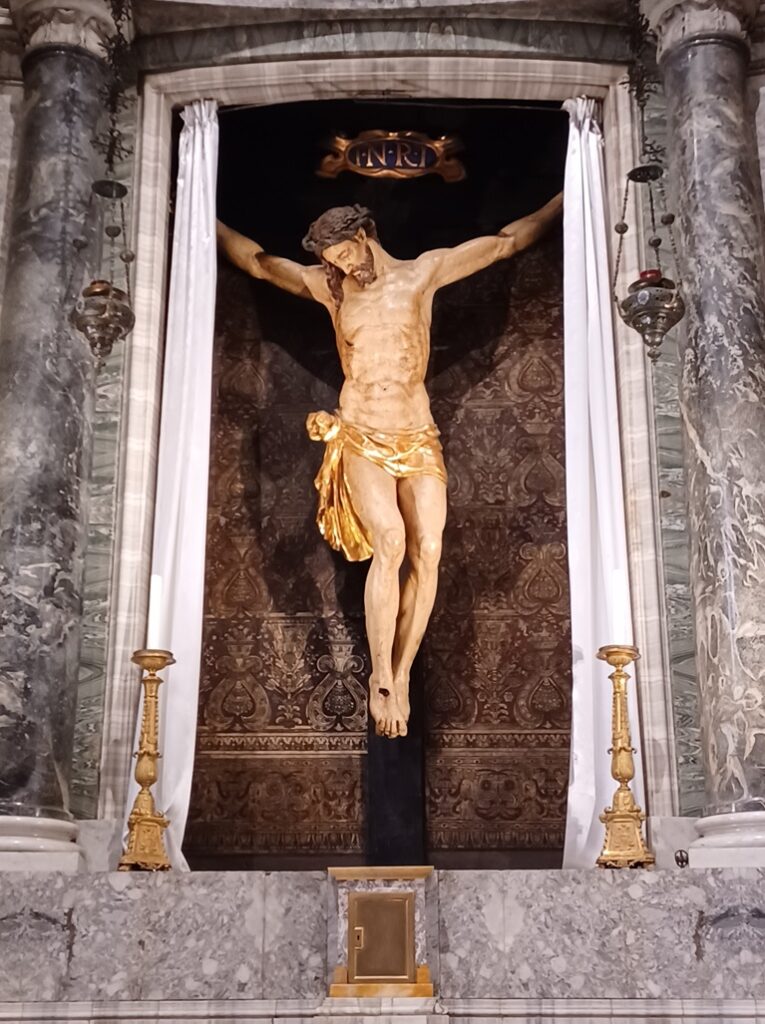
When we think of Jesus as a king, our thoughts often turn to his passion and resurrection.
The writing on the cross INRI – Jesus of Nazareth, King of the Jews. In the Gospel according to Matthew, the same title is also mentioned when Jesus was born.
In Luke’s Gospel, we are reminded of the moment after Jesus’ crucifixion when he was on the cross and still being mocked for not saving himself.
Jesus didn’t fit in their picture of a king who is omnipotent, a king who has the power to decide over death or life – a king feared by his own people and his enemies.
However, Jesus was not chosen to be a ruler but to be an example. Jesus didn’t come to this world to have a good life and to save himself when he was in danger. His kingdom was not ‘of this world’. One of the criminals who was crucified together with Jesus asks him: ‘remember me when you come into your kingdom’. From the passage in Luke, we learn that Jesus promises paradise as an answer to be received in his kingdom.
Christ the King – of God’s kingdom. A place where trust and care replace fear and oppression.
The feast day is also the last Sunday of the Church Year. The last Gospel of the current Church Year ends with Jesus’ death on the cross and the promise to be received into paradise if we repent and choose to follow Jesus.
We are preparing ourselves for the new Church Year and Advent, and we will be starting with the Sunday of Hope.
In the time of “No Kings” protests and royalties being in disrepute, it might be good to remember that good leadership doesn’t need a crown and unlimited power, but rather dedication, compassion and the willingness to serve and care for the people entrusted to the leader.
BM