Amos 6:1,4-7; 1 Timothy 6:11-16; Luke 16:19-31
One of the UN Development Goals was to end poverty by 2015. Now, 10 years after this deadline passed, it is said that the richest 10% of people in the world own about 76% of the world’s wealth, while the poorest half of the population owns only 2%.
The wider the gap between the rich and the poor, the less likely they can put themselves in the other person’s shoes: if a person’s income just covers the costs of living, it is relatively easy to imagine what it is like to have less as there is the risk of losing this income – but there is also the dream of being wealthy. For a poor person struggling to have enough food every day, they can’t imagine having more than they need. Like a rich person who can’t imagine being hungry.
Today’s Readings are about these extremes.
The Prophet Amos warns the wealthy not to be selfish, complacent and wasteful. His writings express a kind of righteous anger on behalf of the poor.
His warning is God’s warning. There is no such thing as permanent comfort. The wealthy who don’t think of tomorrow and don’t help the poor ‘will be exiled first’.
Earlier in his warnings, Amos had criticised those who were more fortunate, performed their sacrifices and other duties, but ignored the needs of the poor. In Amos 5:6, the warning was clear: “seek the Lord and live, or he will sweep through the tribes of Joseph like a fire;”
In his letter to Timothy, Paul gives hope. He points out the importance of living a life that pleases God. He doesn’t refer to rituals but to acting faithfully with others. It is about the work of faith, the labour of love and the never-ending hope. It is through ‘fighting the good fight’ and following Jesus’ example that we might be able to earn eternal life.
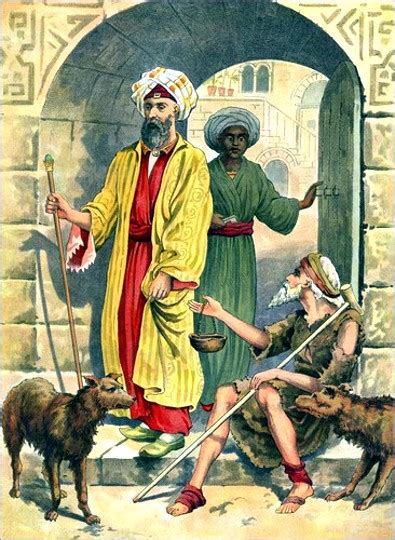
Looking after the poor, the needy and ‘fighting the good fight’. If the rich man in the Gospel of Luke had done so, he would not be suffering after death.
Right after the parables of the Lost Sheep, the Lost Coin, the Lost Son, and the Shrewd Manager, Jesus tells the story about the rich man and Lazarus. The previous parables were about people who took action. They were looking for the lost sheep that would be very vulnerable without the herd, the one coin that rejoiced the woman so immensely when she found it, the son who regretted previous decisions in life and returned to his father – and the manager who quickly acted when he was facing his just punishment.
The story about the rich man and Lazarus is different. They both live close by and yet separately. The rich man who would have had the power to approach Lazarus, to invite him and look after him, doesn’t care. He is busy enjoying his life.
It is surprising that this rich man is not introduced by name. If the story is a true story, Jesus might have tried to protect the identity of this man, but it could be that his name is not relevant or would only distract from the fact that it could be anyone. The poor man, however, is introduced as Lazarus. The name reminds us of Lazarus, the brother of Mary and Martha, and friend of Jesus. The name Lazarus means “God is my help”. In fact, Lazarus doesn’t receive help on earth – but God helps him after his earthly life ends.
Lazarus and the rich man seem to live not far from each other, and even know (of) each other. This makes it even more outrageous that the rich man has no pity with Lazarus. What is the reason for the rich man ignoring Lazarus – is there a story before the story?
As it is indicated in the first Readings, life on earth is not eternal. Everybody has to die someday. However, whereas the Prophet Amos was warning about what would happen, Jesus gives an example of what happened in a particular situation. It is a warning, but it has become very concrete and is a vivid account of the lives before and after death.
The rich man in Jesus’ story would have known about Amos’ warning, but he might have thought that it was God who had chosen him and had blessed him with his wealth – why to worry about a poor man’s suffering?
Once he dies, the rich man wakes up from his illusions. He realises that his account of ‘blessings’ had been exhausted. If he had shared them with Lazarus on earth, they might have lasted for his life after death.
Waking up to this reality scares him. He even starts thinking about others – he wants to warn his brothers. In his desperation, he believes that they would listen to a dead man returning to earth. Does this mean that his brothers also know Lazarus? How would they have recognised Lazarus as having risen from the dead?
Jesus seems to foreshadow what will happen to him. Even one of his disciples, Thomas, later will not believe that Jesus had risen from the dead. Jesus’ words when he shows himself to Thomas were then: “Because you have seen me, you have believed; blessed are those who have not seen and yet have believed.” (John 20:29)
In Jesus’ story, the rich man and Lazarus were extremes, but there are many situations when it is less obvious what to do if we want to take on the ‘good fight’. Do we see the poor and needy around us? These could be people seeking support, love, compassion or just a listening ear and an open heart…
BM