Being a member on interfaith committees is not like being on other committees where you can serve a term of a couple of years and leave. Interreligious dialogue begins with building personal relationships, which require time and ongoing effort. However, when I look at the wonderful friendships that have developed between members of diverse faiths, it makes all the effort worthwhile.
In 2024, Fr Markus Solo Kewuta, SVD, from the Dicastery of Interreligious Dialogue, contacted the New Zealand Catholic Bishops Committee for Interfaith Relations. Originally from Indonesia, he had accompanied Pope Francis on his visit to the country – and hence supported the Pope building bridges between people of different cultures, languages, and religions.
As Fr Markus Solo is responsible for the area of Oceania, he reached out to us and wanted to know more about New Zealand.
The settings of Indonesia and New Zealand couldn’t be more different. While Indonesia is officially a very religious country with most of the population identifying as Muslims, only half of New Zealand’s population identifies as religious. Of those, the Catholics comprise a slight majority (mainly due to immigration).
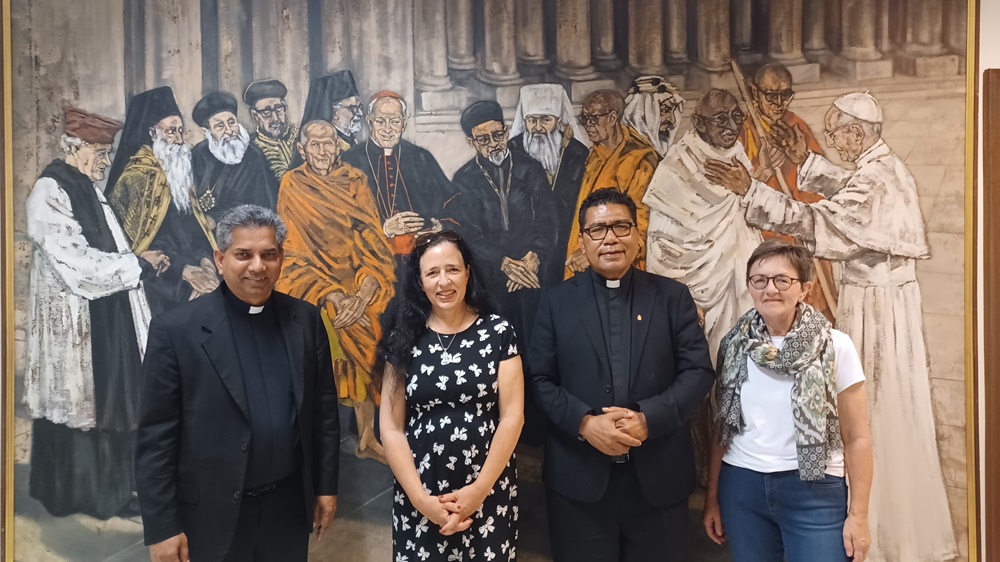
On my pilgrimage to Rome during the Jubilee Year, I took the opportunity to meet Fr Markus Solo in person. From his office, we could see the pilgrim groups walking from the Jubilee Place, the new Piazza Pia, to St Peter’s Basilica. Groups of pilgrims of all walks of life and from all over the world passing by, many of them singing the Jubilee Song in their own language.
While the Dicastery of Interreligious Dialogue might comprise offices and meeting rooms like many other Vatican office buildings, a huge painting captures one’s attention immediately: it is called “Followers of God” and was painted in 1978 by Dolores Puthod. It depicts Pope Paul VI standing in St Peter’s Square with his arms raised to welcome various religious leaders. While the orange habits of some Buddhist monks stand out against the black cassocks of most other dignitaries, the focus is on Pope Paul VI receiving Mahatma Gandhi – both men dressed in white. Gandhi died in 1948, and Pope Paul VI was head of the Catholic Church from 1963-1978. So, this meeting never actually took place. However, it was Pope Paul VI who promulgated Nostra Aetate (“In our time”) on 28 October 1965.
The document Nostra Aetate is the basis of interreligious dialogue for Catholics around the world. One of the key messages from Nostra Aetate is:
The Church, therefore, urges her [children] to enter with prudence and charity into discussion and collaboration with members of other religions. Let Christians, while witnessing to their own faith and way of life, acknowledge, preserve and encourage spiritual and moral truths found among non-Christians, also their social life and culture.
Since its proclamation almost 60 years ago, all our popes have supported interreligious dialogue. It is good to see that Pope Leo XIV has already shown his commitment to continue this work. On the day after his inauguration Mass, he met with delegations from other faith traditions.
BM