Only a few days before the newly elected Pope Leo XIV first visited the Basilica Papale di San Paolo fuori le Mura (Basilica of St Paul outside the Walls) on 20 May 2025, the pilgrims from Bamberg visited this special place. In his Homily, Pope Leo XIV described St Paul’s work as “the basis of every mission, including my own mission as the Successor of Peter and the heir to Paul’s apostolic zeal”.
The Basilica of Saint Paul is the fourth of Rome’s four major papal basilicas on the pilgrims’ schedule (the first three basilicas visited were those of St John in the Lateran, St Peter’s, St Mary Major). It is also one of the city’s Seven Pilgrim Churches. The basilica has been entrusted to the care of a Benedictine community for several centuries but is owned by the Holy See.
The first Christian Roman Emperor, Constantine I, had chosen this site which was said to be the burial place of St Paul. The original church that was consecrated in the 4th century and was eventually replaced by a basilica that underwent many improvements, repairs and embellishments.
Knowing about the long history of a church built above St Paul’s tomb, one would expect an ancient building as so many others that can be found in Rome. However, while the basilica is said to have been the largest church of Christianity in the 16th century, it also has endured many catastrophes: earthquakes, plundering and fires. The most devastating fire broke out in 1823. Pope Leo XII reacted by asking for donations for the reconstruction, and the support received came from individuals, groups and foreign rulers of many countries – and even other faith groups.
Thanks to this support, the basilica was reconsecrated in 1854, just two days after the declaration of the Dogma of the Immaculate Conception.
The bus with the pilgrims crosses the River Tiber, and the tower of the basilica is seen from far. All four buses with pilgrims from Bamberg arrive, and the pilgrims have to go through the usual checkpoints. They enter a very symmetric courtyard, and they learn that it is called a “quadriportico”, an open space surrounded by colonnades on all four sides. It is quite impressive with the beautiful columns, the lawns, hedges, palm trees and statues. This area could be part of a castle, but with the columns also in front of the entrance to the basilica, it is not immediately evident where the access to the church is. In contrast to St Peter’s, the columns are not framing the basilica, but they are rather framing the garden of the quadriportico with the statue of St Paul in the centre.
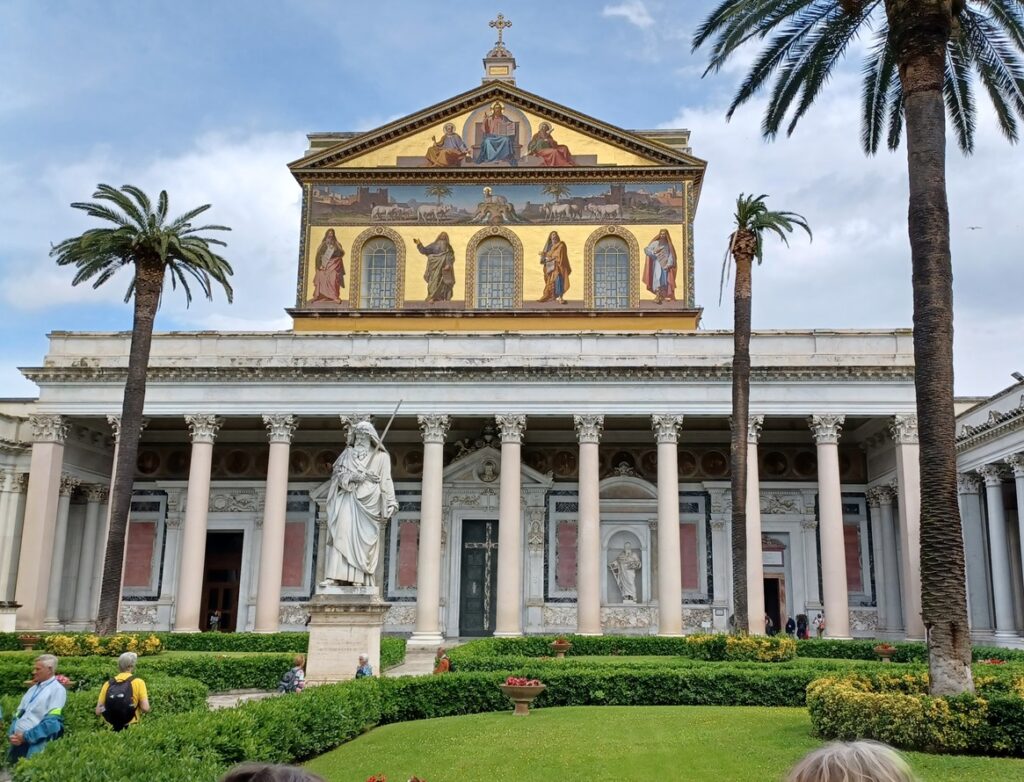
There are 3 entrances to the basilica, and the pilgrims are able to enter the Basilica of St Paul outside the Walls through the Holy Door, which is only open during a Jubilee Year. The view when standing inside the basilica is breath-taking: the beautiful columns on both sides lead you now underneath a stucco-decorated ceiling to the apse with the triumphal arch. The mosaics of the apse are from the 5th-century and show Christ in the middle flanked by the 24 Doctors of the Church, surmounted by the symbols of the four Evangelists and St Peter and St Paul below on each side of the arch.
St Paul seems to point to his tomb which is the centre of attraction for the visitors of the basilica. When you come closer to the tomb, you see a case with chains – allegedly the chains St Paul was wearing during his captivity in Rome.
It is obvious that a church dedicated to St Paul needs to include a picture of Paul’s Damascus experience. The painting of this scene is at one of the altars beyond St Paul’s tomb. When the pilgrims arrive, it is afternoon, and the sun shines through the windows straight onto the painting. There is no way that one can look at the painting properly as the sun ray fully covers Jesus’ hand and one of Paul’s companions. Is this on purpose? It feels like the spectator is asked to understand the situation in which Paul (then Saul) was “blinded by a great light”.
An artwork that points to the importance of this basilica for the popes is a series of papal portraits. This series was initiated by Pope Leo I (440-461) and includes today 267 medallions for St Peter and his 266 successors, including Pope Francis.
The tour guide explains that the legend says that the world will end if there is no more place for another papal portrait. However, new space has been created and there are spaces for portraits of Leo XIV and a few more popes to succeed him.
After learning more about the history of this church and its significance, the pilgrims prepare themselves for Mass. The Franconian brass band accompanies the pilgrims during the Service. Some visitors from different countries stop, look and listen.
St Paul would certainly be pleased to see so many cultures and languages in the basilica that is dedicated to him, the great missionary who said that
“There is no longer Jew or Greek, there is no longer slave or free, there is no longer male and female; for all of you are one in Christ Jesus.”
BM
Series Diary of a Pilgrim