The highlight of a visit to Rome for any Catholic is likely to be the visit to Vatican City – the heart of Catholicism, and particularly the Basilica Papale di San Pietro in Vaticano (Papal Basilica of Saint Peter in the Vatican), in short, St Peter’s Basilica.
The pilgrims from Bamberg arrive at very special times. The world had farewelled Pope Francis, a Conclave was held and after only a couple of days, the new Pope Leo XIV was elected.
Less than a week after the election, the pilgrims arrive at St Peter’s Basilica. The new Pope is elected but not yet inaugurated and is therefore not able to hold General Audiences yet.
The merchants and souvenir shops are still in between two popes. Souvenirs still feature Pope Francis, and the producers of printed souvenir cards had just been informed of the new papal crest that would be printed on pictures with the new pope.
A time of change. While some people only have to remember a new name, the Vatican administration will certainly have busy times ahead just to adapt to a new pope, a new crest, new documents etc.
A truly special time. Long before it was known that there would be a change of pope, the schedule for the pilgrimage included the celebration of a Mass in St Peter’s Basilica with the Archbishop of Bamberg.
In order to avoid queuing up for too long and potentially miss the slot for this special Mass, the pilgrims are at the gates to St Peter’s Square and the basilica by 6.30am, even though the gates only open at 7am. Thanks to skipping the breakfast buffet and being satisfied with a basic surprise breakfast handed out in paper bags before getting on their bus, the pilgrims are in the front part of the queue that gets longer and longer by the minute.
Led by the Archbishop, the pilgrims pass through the security checks and walk towards the almost empty square in front of the basilica. The eyes turn to the balcony where only a few days earlier the “Habemus Papam” was declared. The red curtain is slightly open. Later, the curtains are fully closed before they are completely drawn back open again. Who would be behind the curtain today?
There are hundreds (or thousands?) of transparent plastic chairs on St Peter’s Square. They were probably still there from the funeral for Pope Francis and left there for the inauguration of Pope Leo XIV.
The view is so impressive that time seems to be irrelevant. However, the group leaders keep reminding the pilgrims to walk together to the basilica and then entering together through another Holy Door. Mass is scheduled for 8am, and the clergy needs to get to the allocated places ahead of time. The group follows, with only quick glances around: the famous Pietà by Michelangelo in a glass cabinet on the right, then passing by the second chapel with the altar underneath which the body of Pope John Paul II rests.
Then, the awe-inspiring main altar: Bernini’s baldacchino, apparently the largest piece of bronze in the world, stands beneath the huge dome and above the central altar.
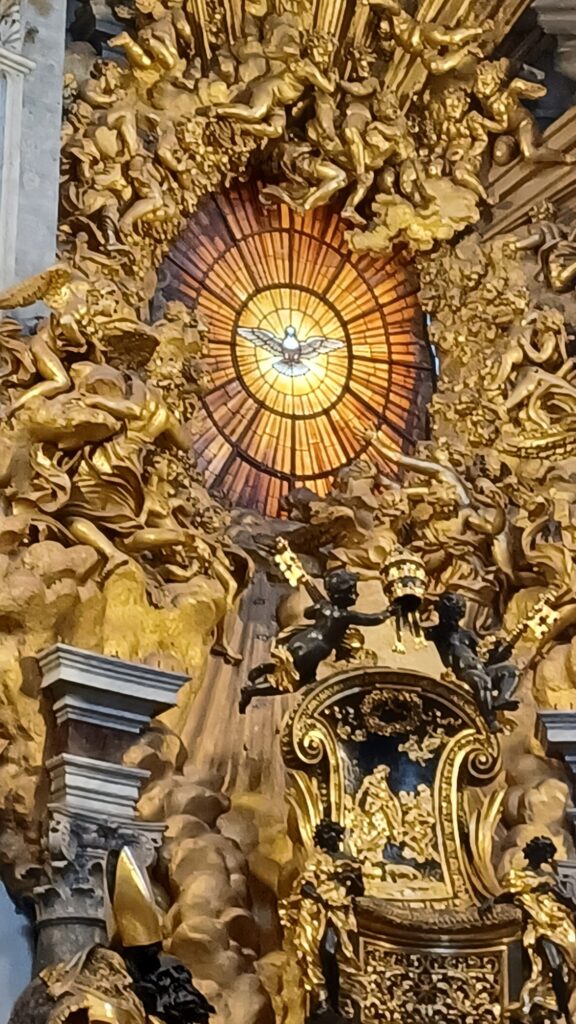
A few steps further is another breath-taking view: the most famous stained glass window depicting the Holy Spirit in form of a dove. Those pilgrims who know pictures of this window are so fascinated to see the original, that they need to look twice to actually see the most revered part of the apse, Gian Lorenzo Bernini’s “Chair of St Peter” (1653). The bronze chair contains an important relic: a chair that many believed to have been used by St Peter.
Here, the pilgrims stop. They learn that it is right here, in this famous apse, that Mass would be celebrated. What an honour and privilege.
The morning sun shines through the beautiful windows and moves slowly while Mass is celebrated. These moments are certainly extraordinary and very precious. There is plenty of time to admire the artwork while listening to the Readings and listening to the Homily.
A true reward for getting up early. The basilica is not crowded yet, and there is a wonderful feeling of being truly in a spiritual place.
After Mass, the group gathers again to leave the basilica together. The pathway now is through the south transept, passing by the bronze statue of Saint Peter. By now, the number of people in the basilica has increased considerably, and it is hard not to lose the group guides. The reflective mood is over, and the reality of being in the most prominent building in Vatican City has caught up with the pilgrims.
As the basilica is still filled with chairs and awaiting the big inaugural celebrations for the new pope, tourists and pilgrims alike are led through channels that don’t allow them to escape of the pre-determined route through the church.
On the way out, the group passes by several beautiful air vents for the crypt that seem to decorate the floors, and then by the amazing sculpture at the tomb of Pope Alexander VII (1671–1678) – another Bernini masterpiece. It shows the pope kneeling in prayer and four female statues representing virtues: Charity holds a child in her arms, Truth’s foot rests on a globe. Then, Prudence and Justice in white marble. The figure of Death is represented in gilded bronze, raising an hourglass to symbolise that time has passed. The extensive and seemingly moving drapery of dark Sicilian jasper immediately draws one’s attention to this monument.
Reliefs with a white dove with the olive branch are present in several versions. A dove turned to the right or the left, white or rather grey.
The dove of peace connects to the first words of Pope Leo XIV: “Peace be with all of you”.
The pilgrims are leaving the church building and look around.
The chimney that workers had attached atop the Sistine Chapel a few days ahead of the election process for the next pope has been taken down already.
Before leaving St Peter’s Basilica, the pilgrims visit the Vatican Grottoes where many popes are buried. It seemed like each tomb carries the Chi Rho, one of the earliest forms of the Christogramme, formed by superimposing the first two letters—chi and rho—of the Greek ΧΡΙΣΤΟΣ. Some tombs are decorated with a picture or flowers or an eternal light. There are sarcophagi and epitaphs, but also quite simple tombs.
Pope Benedict XVI’s tomb is one of the simple ones. He once commented on eternal life:
Eternal life will be like immersing yourself in the ocean of infinitive love where time – a before and an after – no longer exists.
BM
Series Diary of a Pilgrim