The Fontana di Trevi (Trevi Fountain) which was finished in 1762 is certainly the most famous fountain in Rome. Apparently, the name of the fountain derives from the Latin word trivium, meaning “intersection of three streets”.
When walking towards the fountain, the crowds get bigger and bigger. The intersection of the three streets also means that people are coming from all directions to visit the fountain.
Being in such a crowd of people feels so unsafe that it is even challenging to get out a camera to take pictures. Many visitors just hold on to their bags and try to find a way to get to see the fountain.
At the fountain there are security guards, but their focus is on the people next to the water. If someone wants to throw money into the fountain or get a close-up photo, patience is needed. Without spending time in a queue, there is no chance to get close to the fountain.
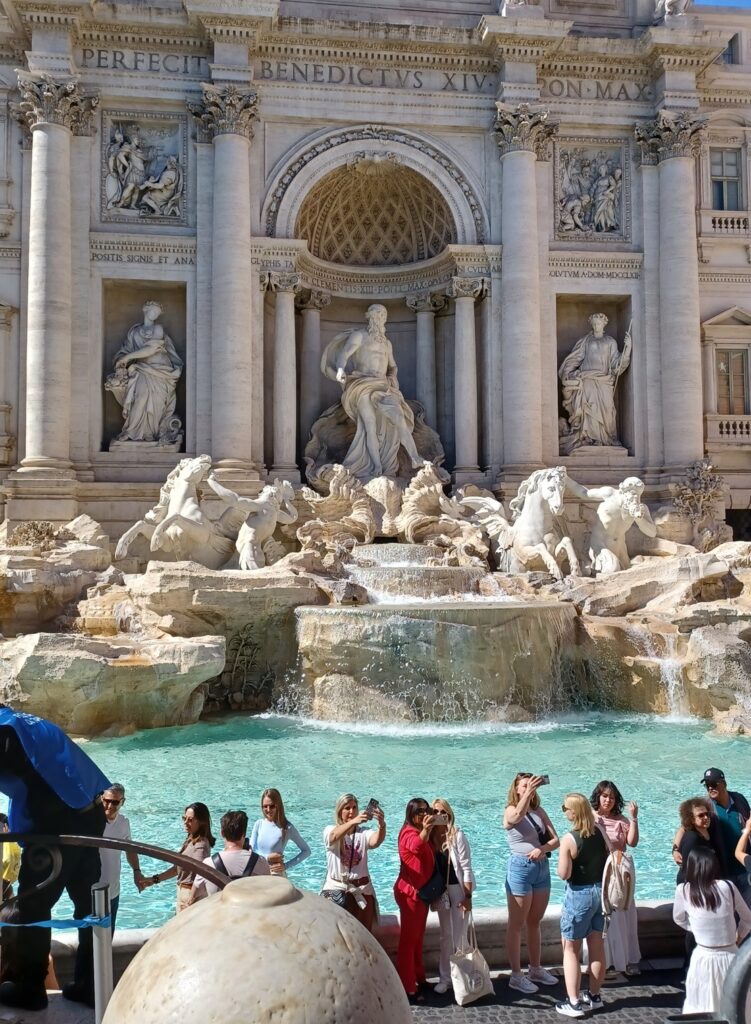
The guide explains the updated rules for the Trevi Fountain: if you throw 1 coin into the fountain, you will come back to Rome; if you throw 2 coins into the fountain, you will fall in love; if you throw 3 coins into the fountain, you will get married – and if you throw 4 coins into the fountain, you will get divorced. An estimated 3,000 Euros are thrown into the fountain every day. It is good to know that the money is donated to charity.
The fountain is beautiful and just like many other fountains, it took a very long time to finish it. The combination of white marble statues, calm and agitated horses and rocks around them is fascinating. Many stories could be told, but there is little chance to really contemplate it.
The group continues the visits to famous places in Rome and reaches the Pantheon which was built in the 2nd century as a Roman temple. Later, it became the Basilica Santa Maria ad Martyres (Basilica of St. Mary and the Martyrs) but is known as “Santa Maria Rotonda”.
Not far from the Pantheon is the Piazza Navona. After the crowds at the Trevi Fountain, this place is a relief: more space, artists and merchants prepared for customers – and another beautiful fountain: the Fontana dei Quattro Fiumi (Fountain of the Four Rivers).
The four statues on the fountain represent the four rivers Danube, Ganges, Nile and Rio de la Plata.
The Piazza Navona is the location of the Obelisk of Domitian. This obelisk was commissioned in Egypt and has become famous through the studies of the 17th century German Jesuit Athanasius Kircher who translated the hieroglyphic inscriptions on the obelisk, hoping that he would discover the hidden wisdom imparted from God to the patriarchs long ago.
Athanasius Kircher was passionate for his studies and loved to accumulate knowledge. He said:
Nothing is more beautiful than to know all.
BM
Series Diary of a Pilgrim