
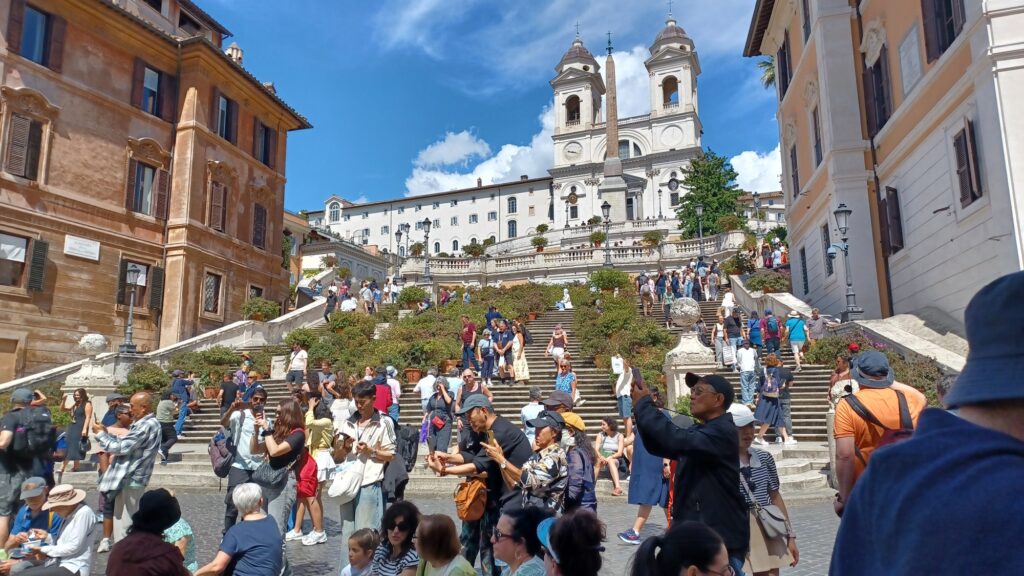
The Trinità dei Monti church is situated above the double staircase which leads down to the famous Piazza di Spagna. The church was built as a Franciscan church in 1503 and is one of the so-called francophone churches.
Standing in front of the church but below its stairs and looking down the hill, neither the staircase nor the Piazza are visible. The first impression is that there is a beautiful wide balcony from where a row of buildings are visible, and this row is cut in the centre by a long road. The architecture and the shape of the buildings might differ substantially, but through this very symmetrical road that seems to part from the centre of the balcony, it gives a sense of unity.
Later, the pilgrims learn that today this very road is known for their luxury shopping stores.
Another element of symmetry at this place is the Sallustian Obelisk which was not imported from Egypt, but rather made in Rome.
Only when you reach the balustrade of the beautiful balcony mentioned above, the Scalinata di Trinità dei Monti (Spanish stairs) become visible. This masterpiece from the 18th century connects the Piazza di Spagna to the Piazza Trinità dei Monti.
The stairs were meant to be the access to the francophone church, but with French cardinals, diplomates and kings as well as the popes having to agree on the stairs, the project took more than 150 years.
There are so many people walking up and down the stairs every day. It comes to no surprise that the stairs were worn out and had to be restored recently. Another problem is the fact that some people like sitting on the stairs. Not only does this make it difficult for others to hold on to the handrails, but immense damage has been done by people playing on the stairs, damaging them or leaving rubbish behind. In their desperation, the city has imposed fines.
Today, tourists like standing on the stairs and having their pictures taken. During springtime, there are pots of azaleas on the stairs which must look beautiful. However, their season had finished by the time the German pilgrims from Bamberg arrived, and the pots with withered flowers were ready to be removed.
Below the Spanish Stairs is the Spanish Place, the Palazzo di Spagna with the Fountain Fontana della Baraccia (Bernini).
The tour guide tells the pilgrims of Bernini’s inspiration: a legend says that, when the River Tiber flooded in 1598, water carried a small boat into the Piazza di Spagna. Apparently, this boat was left in the centre of the square.
The pilgrims are led further away from the stairs. Not having yet had enough time to enjoy the beauty of the place, the stairs and the fountain, another place and monuments are reached.
After coming down the Spanish Stairs from the French church, some pilgrims are still eager to learn why the place is called Spanish Place.
As they reach Piazza Mignanelli which is connected to Palazzo di Spagna, all eyes follow the huge pillar with a statue of Mary on the top: the Column of the Immaculate Conception. This monument was erected in honour to Mary two years after the declaration of the dogma of the Immaculate Conception by Pope Pius IX. The location of the column is also significant – it is in front of the Palazzo di Propaganda Fide (Palace of the Propaganda of Faith).
The bronze statue of Mary stands on a globe and wears a crown of stars. The column is 11.8m high which makes it very difficult to distinguish the details of the artwork. However, a wreath in Mary’s arm is visible. Is it a natural wreath and how did it get there?
The tour guide tells the group that each year, on 8 December, the day of the Feast of the Immaculate Conception, the mayor of Rome and other dignitaries as well as many others visit the monument for a ceremony. The Pope often also participates, places a bouquet of white roses at the base of the column and prays for her intercession to help all people in their suffering and struggles.
Before the prayers, firemen put a wreath on Mary’s right arm. It remains there until the next year when it gets exchanged against a new one.
On the bottom of the pillar are four representatives of the Old Testament whose writings are said to refer to Mary: Moses, King David, Ezechiel and Isaiah.
Finally, the group turns around and sees the Spanish Embassy to the Vatican. The Embassy of Spain to the Holy See is the oldest permanent diplomatic mission in the world. It was created in 1480 by King Ferdinand the Catholic.
Hence, this embassy was there long before most other buildings and artwork in this area – and it is now clear why the famous stairs are said to lead to the Spanish Place.
Apparently, the location of the embassy was one of the reasons why the Column of the Immaculate Conception was erected here in 1857. Spain was known for defending this feast for centuries.
The thoughts turn to St Maximilian Kolbe who once said:
Prayer is powerful beyond limits when we turn to the Immaculata who is Queen even of God’s heart.
BM
Series Diary of a Pilgrim


