The Basilica of St Sebastian – the first stop in Rome. There are four different groups of pilgrims participating in the same pilgrimage and this is the first time they meet.
The way to this basilica is beautiful for the travellers who are driven, but certainly not easy for the bus drivers. The roads are small and big trees on both sides of the roads give the impression that you are in a countryside rather than aiming to an important church.
What a surprise when the guide suddenly points to one of the side roads, to a road made up of paving blocks – part of the famous Via Appia, the Appian Way. This is one of the earliest Roman roads that crossed the southern part of the Roman Empire (Rome to Brindisi) which was initiated by the Roman censor Appius Claudius Caecus in 312 BC.
It is said that St Paul and many other Christians used this road to enter Rome.
The basilica San Sebastiano has a paved gathering space in front of the building, but otherwise, the property is rather hidden between other houses.
It is hard to believe that it was one of the seven basilicas which travellers to Rome traditionally visited since the 16th century. This pilgrimage of seven basilicas included also St Peter’s Basilica and the Basilica di Santa Maria Maggiore. Hence, the name of the street: “Via delle Sette Chiese” (Road of the Seven Churches).
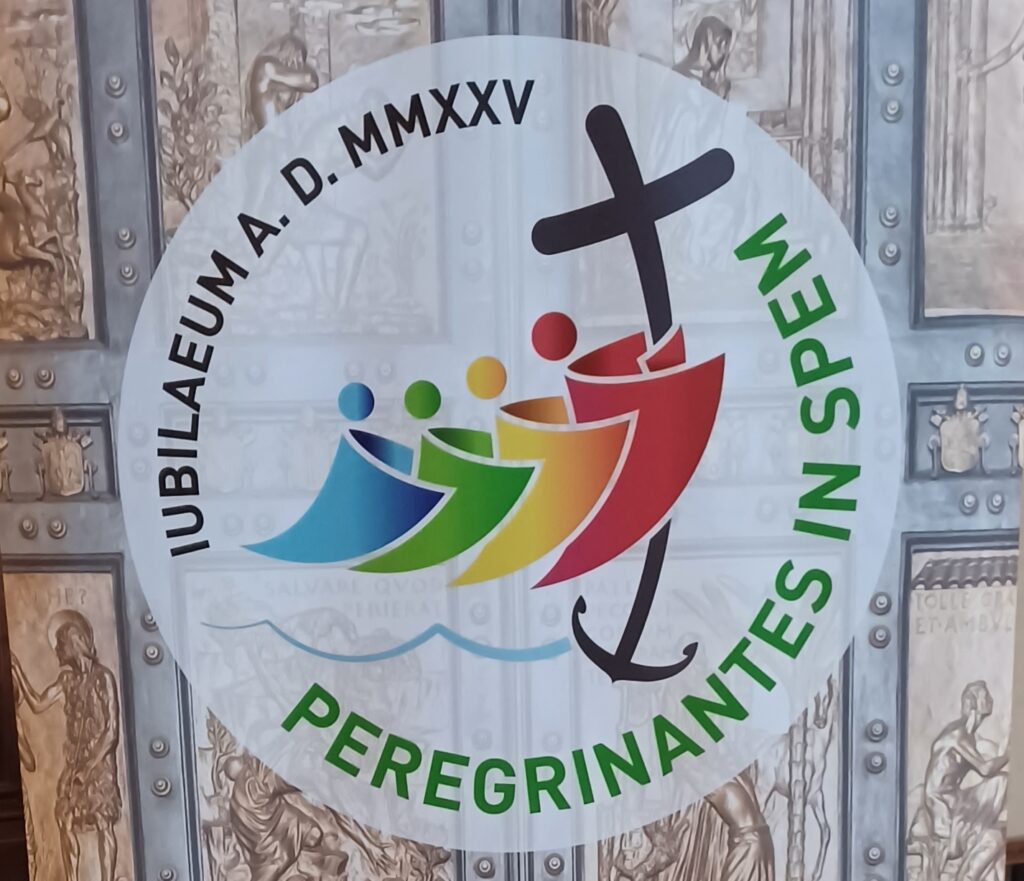
A truly appropriate place to celebrate the first Mass of this 2025 Pilgrimage. When entering the church, the well-known logo of the Year of Hope welcomes the faithful in Latin: Peregrinantes in Spem.
While the basilica was built in the 16th century, the first church on this site (above the catacombs) was apparently built in the 3rd century which was the time when St Sebastian was martyred. His remains were kept in the church from the 4th century until they were moved to St Peter’s Basilica in the 9th century.
There are still several relics in the basilica which include an arrow from St Sebastian’s martyrdom and a set of marble footprints that are attributed to Jesus – did he really walk to Rome along the Via Appia?
This sacred space has a long history. Many early Christians wanted to be buried close to the martyrs, and so the catacombs witness the pain and persecution they had to suffer before Christianity was accepted in Rome. These were underground burial chambers for Christians who were not able to be buried within the city walls.
With the bus arriving late afternoon and Mass starting at 5pm, the group of pilgrims whose bus arrived last, were not able to visit the catacombs, but they knew that they were standing on holy ground. Thoughts go to the many Christians who are being persecuted and killed for their belief today…
The first Mass of the pilgrimage is a thanksgiving Mass for the pilgrims’ save arrival. The joyful songs of the Franconian pilgrims were accompanied by their brass band and a pilgrim organist.
To everyone’s surprise, the brass musicians entertained the crowd after Mass outside the basilica – with other pilgrims and tourists watching and visibly enjoying the atmosphere.
Given that the papal election has been very recent, the Prayer of the Faithful includes:
We pray especially for Pope Leo whom You have chosen to be the Good Shepherd.
Give him courage and strength for his important ministry.
BM
Series Diary of a Pilgrim