Naw-Rúz is the first day of the Baháʼí calendar year, and one of eleven holy days for adherents of the Baháʼí Faith. It occurs on the northern vernal equinox, usually on the 20th or 21st of March.
This year, the Baháʼí community on Auckland’s North Shore invited to Te Kamaka Marae which is part of the former Hato Petera College (1928-2018), a school with a strong Catholic and Māori character.
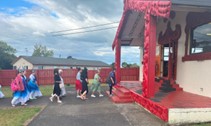
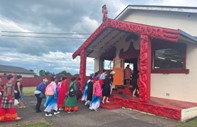
Followed by the karanga, the call to be received into the wharenui, the host greeted the guests who were from a diverse range of ethnicities: Māori from New Zealand and Cook Islands, Europeans, Indians, Pakistani, people from the Middle East and even a group of Chinese women who later performed some dances.
The first guest speaker was Beate Matthies. She was invited in her role as the co-president of the Auckland Inter-Faith Council and as a member of the NZCBCIR, the New Zealand Catholic Bishops Committee for Interfaith Relations.
She could easily connect the host’s mihi and the waiata he had chosen (Mō Maria) to the history of the Catholic Church in the country. The hym “Mō Maria” is attributed to the Catholic Bishop Jean-Baptiste Pompallier who arrived in Northland, in the beautiful Hokianga, in 1838.
Bishop Pompallier also played a very important role in the writing of the 4th Article of New Zealand’s founding document, the Treaty of Waitangi – the article that protects the freedom of religion and belief.
This connection to Bishop Pompallier was important in two ways: many of the Māori who were present in the wharenui were originally from Hokianga, and many others in the room had emigrated from countries where they had been persecuted for their faith.

The letter from the NZCBCIR was another point of connection between the Catholics and the Baháʼí community where it was said, referring to Pope Francis: “We note a resonance with our own tradition, as our Pope Francis too has often incorporated the themes of interreligious dialogue and human fraternity in his writings and speeches. Dialogue is a way of life for him, as it is a gift for us as we work with others in seeking harmony in Aotearoa. In this context, we are blessed to celebrate the creation of friendships across boundaries as a way of healing our wounded world“.
Nikola Poliko, a member of the Auckland Spiritual Assembly addressed the gathering, followed by Gray Gibson, the Chairman of the Baháʼí Auckland Spiritual Assembly. He spoke as to what Naw-Rúz was about: a spiritual springtime, and a spiritual renewal after fasting.
The Baháʼí leadership conveyed special New Year’s greetings and acknowledged the work of interfaith and the many volunteers in Auckland who were tirelessly engaged in building up hope, solidarity and contribute to harmony among people of different faiths.
This work with and for the people is reflected in the often-quoted Māori Proverb: “He aha te mea nui o te ao? He tangata, he tangata, he tangata.” which translates to “What is the most important thing in the world? It is the people, it is the people, it is the people.”
BM